Posts Tagged ‘New York Times’

Life at the confluence

Saturday, January 23rd, 2010
The prototypical confluence

The prototypical confluence

It was a regular, and solemn, invocation for Monday Night Football in the years when the Pittsburgh Steelers turned up there as often as ABC and the NFL could manage it: Howard Cosell, in his fullest declamatory splendor, telling America that he and we would spend the next several hours “at the confluence of the Al-le-ghe-ny and Mo-non-ga-he-la Rivers” – the origin of the Ohio River, and therefore the very eponym of Three Rivers Stadium.

There are a couple of football games this weekend that don’t include the Steelers, but we are spending the end of January at a confluence nonetheless.  Two mighty rivers of ink are flowing together, inexorably, even as we speak: that which has been spilled in anticipation of the Apple tablet, and that which has been spilled in anticipation of the emergence of a coherent strategy for paid news content on the World Wide Web. For a handy list o’ links that should satisfy your need to drown in either river, visit the Nieman Journalism Lab for Mark Coddington’s week in review.

Perhaps it was when Bill Keller, editor of the NYT, talked about an “impending Apple tablet” to his staff in October that the stories became inevitably linked.  But, once the Times sketchily sketched out the state of its sketchy plans on Wednesday morning, we had to wait less than 24 hours for the heartwarming Wall St. Journal headline, “Apple Sees New Money in Old Media.”

In between – actually, just a few minutes after the Times announcement on Wednesday – I was in front of a class of first-quarter Medill graduate students, introducing them to some of the ideas that I flesh out further in my current class, “How 21st Century Media Work.” The Q&A centered not on the Times, but on the larger question of finding the money to support the journalism they feel called to do.

As a matter of fact, my answers dipped a toe into each of the merging rivers.

  • I do expect to see models for paid content emerging, and this year; some will be for-profit (GlobalPost), some low-profit (Chicago News Cooperative), some nonprofit and intentionally so (Texas Tribune).  They will have in common a focus on what their users find valuable, not their managers.
  • I do expect that many new devices will carry with them ways to extract revenue in exchange for the convenience or other value they bring; the media’s battle for desktop revenue will be miserable, but the chance for different models to flourish in the palm of your hand seem high.

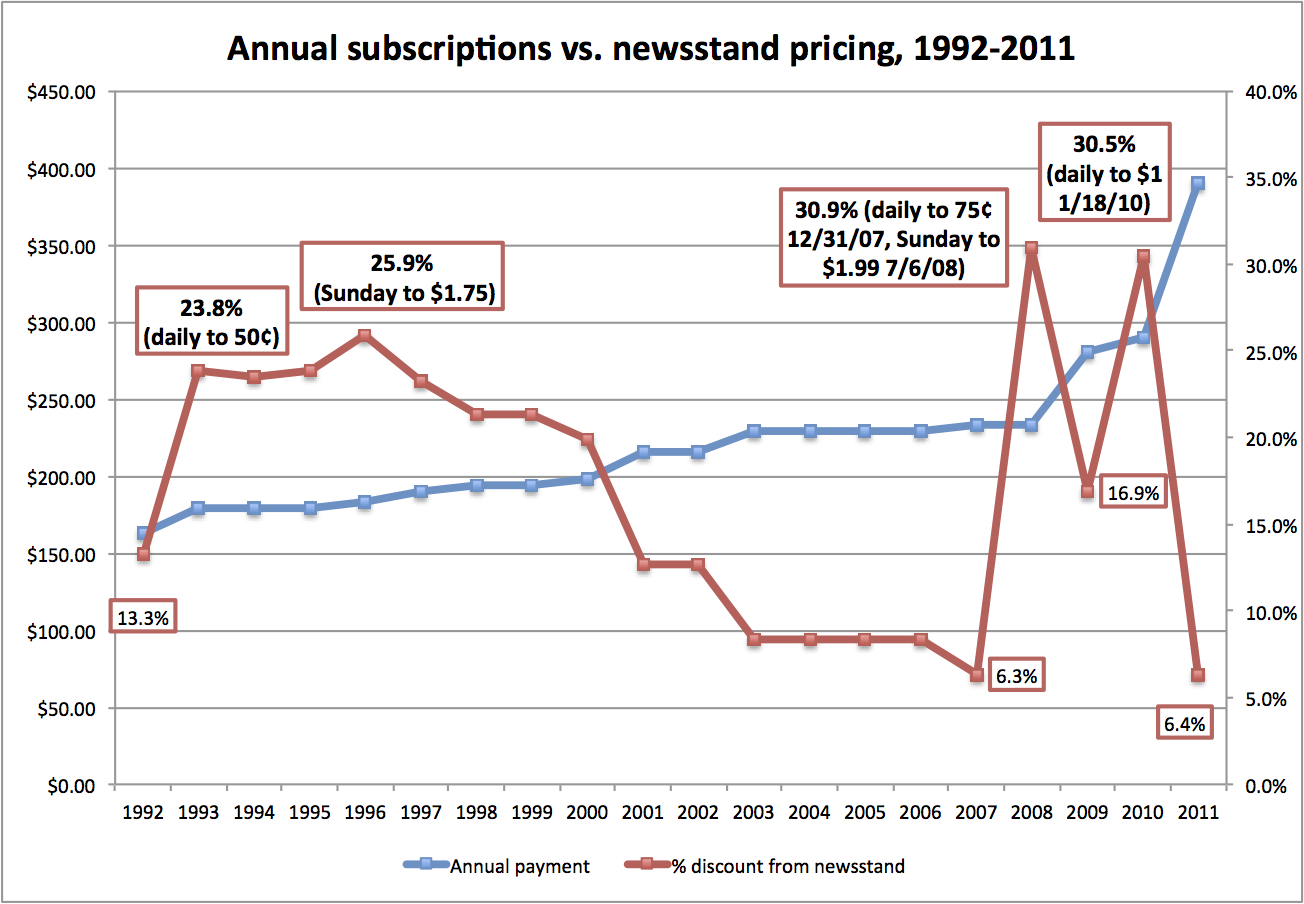
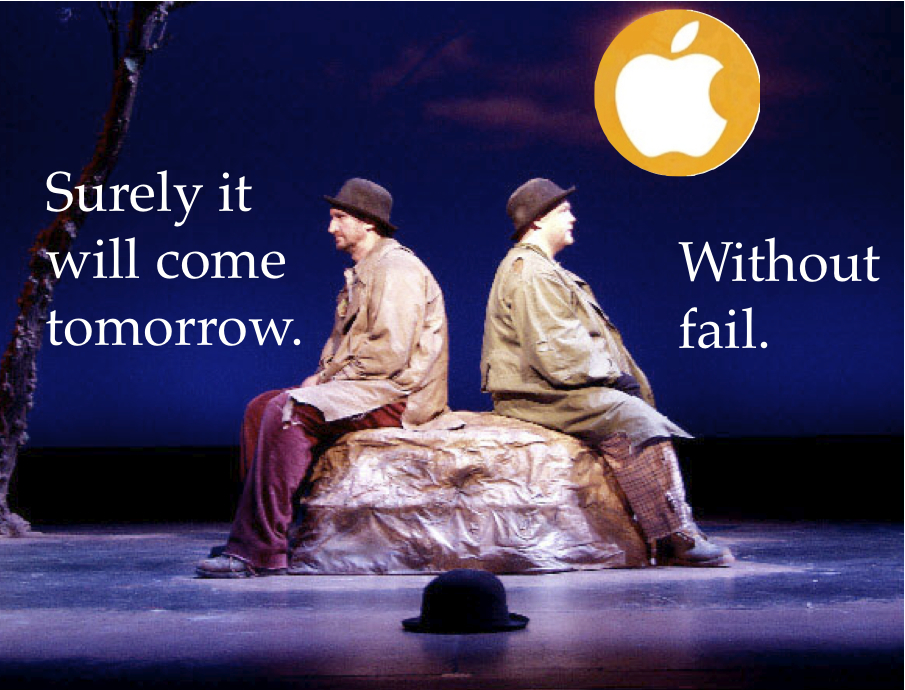
Meanwhile, it’s back to waiting – till 2011 for the debut of the Times pay wall; till next Wednesday for whatever it is that Apple wants to tell us. Hey, Vladimir!  Hey, Estragon! Can I wait alongside you?

cropgodot

So Twitter ‘will endure’?

Sunday, January 3rd, 2010

(Adapted from a post to the internal discussion board for my winter 2010 Medill course, “How 21st Century Media Work”)

“I’m convinced Twitter is here to stay,” David Carr writes in Sunday’s New York Times. “And I’m not alone.”

I’m thinking he’s probably right, and for the same reason: “the real value of the service is listening to a collective voice.”

It didn’t start that way for me any more than it did for Carr. It was July 16, 2007, when the Tribune’s Brad Moore told me about a new text-messaging service that RedEye had started to play with. He was reporting to me as its general manager then, and his folks were doing their best to stay on top of communication trends that its twentysomething readers were starting to embrace.

As it happened, I wouldn’t even join Facebook till August of that year, and FriendFeed, Fark, and Digg were even further in the future. Anyway, I signed up, though I didn’t get around to “tweeting” for another month. And it wasn’t until 2008, when the interns that I’d hired to build the Tribune’s social media profile started to show how Facebook + Twitter + Digg = Pageviews, that it dawned on me that those 140-character messages might be a big deal. So I opened a second account — @YoungOwen, the one I’m still using today, since I have been unsuccessful in getting Twitter to untether my first one from my extinct Tribune mobile phone.

And sure enough, I’ve learned enough from tweeting and reading other people’s tweets to see that, like fax machines and filing cabinets, this service is something that’s not going away. As Carr observes, it has become part of the infrastructure; he quotes Clay Shirky: “Anything that is useful to both dissidents in Iran and Martha Stewart has a lot going for it.”

It goes (almost) without saying that the precise business model hasn’t quite emerged. But let me be the one millionth person to note that countless companies are piggybacking on it, mining the real-time “statusphere” or “Twitterstream” to keep track of their brands, promote themselves, or find potential customers. All of those uses are applicable to journalists and media companies as well as technologists and gossips.

It is a peculiar and arcane skill, tweeting something that might be of interest to people you don’t know (which can happen all the time with the right #hashtag). But since journalists need to do that nearly every day in their “real lives,” it seems also to be a useful one.

If you’re not on Twitter, you could do worse than to follow Carr (@carr2n) and the nine users he highlights. You might well wind up deciding to tweet what you learn.

Co-operative-etition, Chicago style

Tuesday, November 24th, 2009

The festival of links you can create these days when writing about new business models for the news industry is a wonder to behold. As we have noted here before, it seems sometimes there are almost as many conferences on the topic as there are stories about paid content, most of them involving Rupert Murdoch and/or Google.

Chicago News Cooperative logoOne prominent example, of course, is beginning to play out right here in Chicago: The Chicago News Cooperative launched last week, publishing two-page reports in the Friday and Sunday editions of the New York Times. I of course am watching with much interest, given that, by my count, I worked at the Tribune with around three-quarters of the 20 people named on the staff page today.

I suspect the Tribune and Sun-Times are watching with interest, too, given that the Tribune chose Sunday to publish another [not "the second" as originally reported--ORY] in a series of spadeas about its priorities (Capturing the Chicago Experience – click to download PDF, 3.44 mB). Its letter to readers from editor Gerry Kern ends, “We are Chicago’s newspaper. We tell your stories.”

(By my lights, the most remarkable thing about the Chicago News Cooperative example is that the NYT’s own journalists actually wrote about the launch. I guess that’s another example of how the world is changing; in the Olden Days, writing about anything your employer had done to try to improve its business prospects had a good chance to get you hooted out of any newsroom in America.)

But let’s not spend any more time here on background.  If you want more, read Alan Mutter’s piece at “Reflections of a Newsosaur” from earlier this month. Instead, let’s see what Chicago readers found in their driveways and newsstands Friday and Sunday morning, and not just in the NYT (using the acronym consistently today, to avoid confusion).

After all, CNC editor Jim O’Shea and his colleagues say they’re not out to supplant the existing newspapers; they are out to protect and sustain a kind of reporting they perceive as threatened, the public-service journalism “that we feel is crucial for a democracy . . . and provide accountability for the institutions and public officials in the city, county and state.” (Quote is from a WTTW interview with O’Shea, video after the jump.)

(more…)

Dead trees and dying cities

Thursday, October 22nd, 2009

The New York Times’ decision to add pages of metropolitan-area news to copies of the papers circulated in San Francisco (last week) and Chicago (Nov. 20) is, if nothing else, an interesting juxtaposition with its nearly contemporaneous announcement of 100 layoffs in the newsroom. By contracting with newly formed local news entities, it doubtless will acquire high-quality content at less cost, and with less long-term liability, than had it staffed up to do the same thing (or had transferred folks to the hinterlands).

Official word came today that in Chicago, several of my former Tribune colleagues are launching the Chicago News Cooperative – not only to supply stories to the Times, but also to repopulate some of the beats and coverage areas that have been affected as the Chicago papers have laid off staffers, reduced newshole, and changed their focus and approach. (When current Tribune editor Gerry Kern delivered the Crain Lecture here at Medill recently, the editorial changes at the Tower were among the topics he addressed; the text of the lecture is here, and here is an interactive video that includes both his remarks and the slides he used to illustrate them. The video requires Microsoft Silverlight. The fact that I delivered the introduction to the lecture may be reason enough not to download Silverlight and view it.)

Of course, the number of Starbucks available to sell the Friday and Sunday NYT in Baghdad-by-the-Bay and Beirut-on-the-Lake might also be a reason for the Times to start its metro news initiative in those two cities.  But I think an answer even deeper than journalistic idealism or straight competitive instincts is lurking in the cover story of the November issue of Harper’s, by Richard Rodriguez: “Final Edition: Twilight of the American Newspaper.” (It’s not available online except to subscribers.)

Wrinkle in Time (detail), by Steve Mills: Cover art from the November issue of Harper's.

Wrinkle in Time (detail), by Steve Mills: Cover art from the November issue of Harper's.

Rodriguez got my attention back in June when he gave an interview to New American Media on “The Death of the SF Chronicle” that included the following: “I don’t think the Chronicle is dying so much as I think that San Francisco is dying. When a metropolitan newspaper of that magnitude  stops publication it indicates that there has been a death of the metropolitan ideal.”

This piece in Harper’s expands on his theme of “the death of place,” but also is far more expansive on the Chronicle in particular, newspapers in general, and most especially of San Francisco.

(more…)

Throw out this lifeline

Tuesday, September 15th, 2009

Throw out the lifeline with hand quick and strong:
Why do you tarry, why linger so long?
See! he is sinking; oh, hasten today
And out with the lifeboat! away, then away!

(Refrain:)

Throw out the lifeline! Throw out the lifeline!
Someone is drifting away;
Throw out the lifeline! Throw out the lifeline!
Someone is sinking today.

– From the hymn by Edwin S. Ufford, 1888.

Today I was one of six lecturers at the annual kickoff symposium for “Know Your Chicago,” a 61-year-old fall tour series run out of the University of Chicago’s Graham School of General Studies. What quickly became clear as I delivered my talk, “When Worlds Collide: The Journalist, Technology, and the Audience,” was that this particular audience … several hundred folks who were mostly my age and older, mostly women … was deeply invested in being reassured about their morning newspapers.

In fact, I was only interrupted by applause twice, and then only in the Q&A:  once when I said I was one of those folks who valued having a printed paper in the morning, and once when I opined that some newspapers would certainly be around as long as I am (or words to that effect).  This after I had pointed out that Col. McCormick’s classic definition of a newspaper —

“The newspaper is an institution developed by modern civilization to present the news of the day, to foster commerce and industry, to inform and lead public opinion, and to furnish that check upon government which no constitution has ever been able to provide.”

— really didn’t require that the newspaper actually exist in newsprint form. What folks cherish is the idea of a newspaper, whether the Colonel’s or someone else’s.

(more…)

Read on the Fourth of July

Sunday, July 5th, 2009

Ah, Independence Day: life, liberty, and the pursuit of the written word.  I know I didn’t actually read 233 articles today (one for each year since the Declaration), but I gave it my best shot….

  • “He blanked Joseph Jackson from his life and excised him from his face, but could not forget his father’s exhortation to be ‘a winner, not a loser.‘ ” Where else but The Economist would you expect to find such an pithy, opinionated, and worthwhile obituary of Michael Jackson? No punches pulled here, nor any failure to acknowledge his “real, hard-won achievements.” By putting this together with Bob Herbert in Saturday’s NYT, methinks I am done with Michael for a few months. Or years.
  • “It’s not just the statisticians who wonder whether our heroes achieve records more often than coins. Psychologists, and, increasingly, economists, also puzzle over the seemingly discrete worlds of chance and perception.” In The Triumph of the Random in Friday’s WSJ, Leonard Mlodinow of Caltech reminds us that “Extraordinary events, both good and bad, can happen without extraordinary causes, and so it is best to always remember the other factor that is always present—the factor of chance.” (By, er, chance, a couple of hours later I began reading the typescript of a friend’s next book – which at one point moves the analysis of cause-and-effect from the realms of mathematics and probability into that of neuroscience. Yes, I had time to read more than newspapers and magazines!)
  • “Swedes believe that consensus is the best way to take long-term decisions that all can live with.” Well, that explains a lot about me, I guess, if you go for nature over nurture.  The Economist again, this time in Charlemagne’s column, Those exceptional Swedes. Oh, and elsewhere, the sensible Swedes who run Ikea get props for suspending investment in Russia due to, ahem, the “unpredictable character of administrative procedures” – read graft and corruption. As Charlemagne pseudonymously puts it, “Sweden, in short, is an exceptional place.”
  • (more…)

A by-the-book reader meets the Kindle (NYT)

Saturday, May 30th, 2009

The slim, envelope-size Kindle is undeniably convenient, even for the curmudgeonly. – Picture caption from  By-the-Book Reader Meets the Kindle – NYTimes.com.

==

This first-person article about the accommodations that even a “curmudgeon” is willing to make when the technology is good enough, and the use case is right, to me is another confirmation of my hypothesis that the Kindle is showing the way toward a future in which people get paid for the content they are able to deliver conveniently (emphasis most emphatically mine).  ’Nuff said; go read it.

Hmmm. Should Peter Pan have signed up for unlimited texting?

Wednesday, May 27th, 2009

It was 1995 or so when I first came across Sherry Turkle. Her book, “Life on the Screen: Identity in the Age of the Internet,” was intriguing academics, scaring parents, and launching incomprehensible book reviews from coast to coast.

Now, a quick word of caution: You can’t apply today’s context to the title. The MIT professor’s book was focused not on the just-emerging World Wide Web, but on the role-playing games that had been proliferating online and the people who inhabited the MUDs – multiple-user domains – that helped define them. Guess what: some of them viewed “RL” (real life) as just another role-playing game … another “screen” to be navigated through … and as such a world no more or less valid than that inhabited by any of their avatars.

But no, that’s not the scary part. (more…)