Archive for the ‘Crystal-ball gazing’ Category

Life at the confluence

Saturday, January 23rd, 2010
The prototypical confluence

The prototypical confluence

It was a regular, and solemn, invocation for Monday Night Football in the years when the Pittsburgh Steelers turned up there as often as ABC and the NFL could manage it: Howard Cosell, in his fullest declamatory splendor, telling America that he and we would spend the next several hours “at the confluence of the Al-le-ghe-ny and Mo-non-ga-he-la Rivers” – the origin of the Ohio River, and therefore the very eponym of Three Rivers Stadium.

There are a couple of football games this weekend that don’t include the Steelers, but we are spending the end of January at a confluence nonetheless.  Two mighty rivers of ink are flowing together, inexorably, even as we speak: that which has been spilled in anticipation of the Apple tablet, and that which has been spilled in anticipation of the emergence of a coherent strategy for paid news content on the World Wide Web. For a handy list o’ links that should satisfy your need to drown in either river, visit the Nieman Journalism Lab for Mark Coddington’s week in review.

Perhaps it was when Bill Keller, editor of the NYT, talked about an “impending Apple tablet” to his staff in October that the stories became inevitably linked.  But, once the Times sketchily sketched out the state of its sketchy plans on Wednesday morning, we had to wait less than 24 hours for the heartwarming Wall St. Journal headline, “Apple Sees New Money in Old Media.”

In between – actually, just a few minutes after the Times announcement on Wednesday – I was in front of a class of first-quarter Medill graduate students, introducing them to some of the ideas that I flesh out further in my current class, “How 21st Century Media Work.” The Q&A centered not on the Times, but on the larger question of finding the money to support the journalism they feel called to do.

As a matter of fact, my answers dipped a toe into each of the merging rivers.

  • I do expect to see models for paid content emerging, and this year; some will be for-profit (GlobalPost), some low-profit (Chicago News Cooperative), some nonprofit and intentionally so (Texas Tribune).  They will have in common a focus on what their users find valuable, not their managers.
  • I do expect that many new devices will carry with them ways to extract revenue in exchange for the convenience or other value they bring; the media’s battle for desktop revenue will be miserable, but the chance for different models to flourish in the palm of your hand seem high.

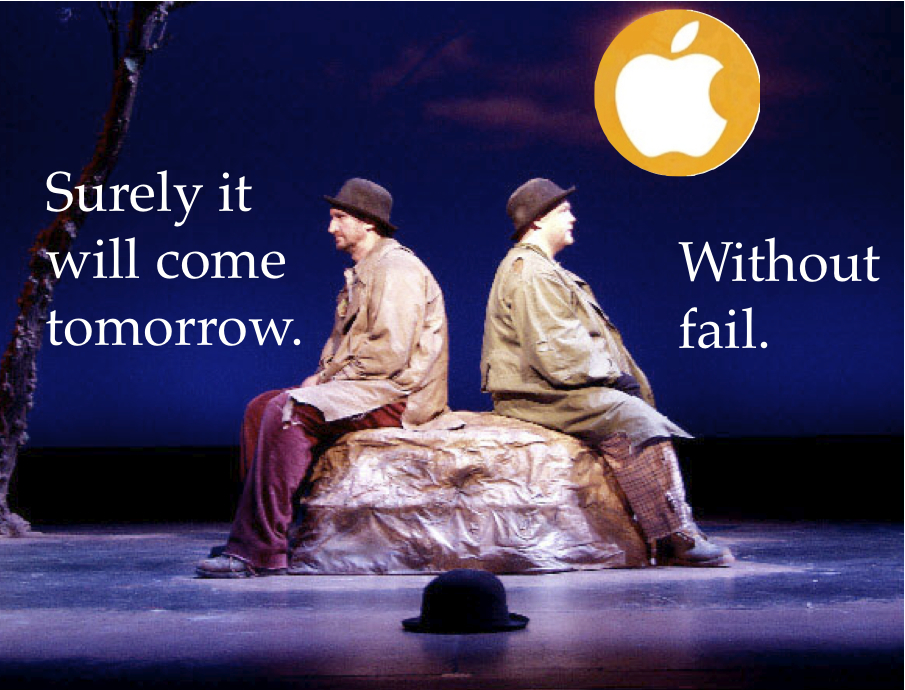
Meanwhile, it’s back to waiting – till 2011 for the debut of the Times pay wall; till next Wednesday for whatever it is that Apple wants to tell us. Hey, Vladimir!  Hey, Estragon! Can I wait alongside you?

cropgodot

Looking for business models? Mind the gaps

Friday, October 30th, 2009

I suppose that every day is a good day to talk about how and whether the journalistic enterprise will remain commercially viable as the world turns in these days of our lives, or indeed whether all my children can recover from their financial ailments, be released from the General Hospital, and find a guiding light to lead them to the promised land of free cash flow. Progress on “new business models,” however, seems to move along at about the same pace as a soap opera plot – even though hardly a day passes without an announcement that someone is going to try something new, or someone else is going to essay something old in a new way.

Indeed it was thus on Thursday, a day when I opened the New York Times to read about the plans by the folks behind Politico to compete online with the Washington Post on local news. And I was actually in a good spot to keep thinking about their admission that they didn’t know how the Web economics might work; since the dean of Medill, John Lavine, had another commitment, I was at Harvard, sitting in at an “executive session” on, ahem, news business models.

Entitled “How to Make Money in News: New Business Models for the 21st Century,” the event gathered an intentionally small group at the Charles Hotel in Cambridge: about 20 panelists for the day’s three discussions, and about 30 additional participants on hand both to listen and to take part. Alex Jones, director of the Joan Shorenstein Center on the Press, Politics, and Public Policy, and author most recently of Losing the News: The Future of the News that Feeds Democracy, was the convener.

As it turned out, the three panels were so packed with speakers with something to say  that many of us other participants – who sat in chairs ringing a central square of tables where the panelists faced one other – got in our licks à la mode du 21ème siècle: 140 characters at a time.

Now, granted, this may not have been optimal.  In her prepared remarks, MIT’s legendary Sherry Turkle – generously not calling attention to anyone seated behind her or on the flanks – pointed to the substantial body of research that shows “your ability for any single task goes down when you multitask. No matter how much we want to jump on the bandwagon, multitasking degrades performance.”

I therefore must cop to the fact that none of my listening, note-taking, or tweeting were as good as they might have been. On the other hand, I must also say that those of us who were intermittently posting and reading got a window in what an additional 10 people were thinking, were piecing together, or were valuing as interesting (or, in some cases, not thinking, not piecing, not valuing). If you’re interested, you can recreate the moment by searching Twitter for the hashtags #Shorenstein and #newsmoney, with far more at the former; I certainly won’t get to all the sound bites here. My own tweetstream is at twitter.com/YoungOwen.

Multitasking, Harvard Square style: in-mirror televison

Multitasking, Harvard Square style: in-mirror televison

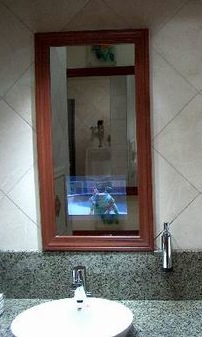
(Oh, while we’re on the subject of multitasking, staying at the Charles Hotel provided me with a new model.  I guess they’ve been around since 2006 or so, but the Charles’ bathrooms feature “in-mirror TV’s” from a company called Séura, whose web site explains, “Enhanced color correcting technology allows the LCD picture to appear when on, while flawlessly concealing the screen behind a bright reflection when off.” Turkle, I am sure, would rightly caution us that there is a risk of degrading the quality of one’s ablutions in the process.)

Turkle’s actual multitasking point, by the way, was centered on how journalists should choose their methods and channels of communicating. “Newspaper reading creates a ‘reading space’ that journalism occupies,” she said. “The teenagers I study leave us with a profound question: Will we be able to have journalism when we don’t have newspapers to appear in? Reading on the Web, if it is all you do, does not favor complex lines of thought. So the implication for news is to stay with narratives that need to be read with all one’s attention.”

(more…)

Who will pay?

Friday, September 11th, 2009

It was a piquant question . . . well, piquant if you took it the right way . . . and then-Chicago Tribune publisher Scott Smith seemed to ask it at all the right times.

“Who will pay?”

There was never any shortage of product ideas, and in fact never a shortage of good product ideas, at the Tribune during Scott’s era, roughly 1997 to 2008. For nearly all of these ideas, it was a simple matter to quantify and project the costs. For nearly as many, it was pretty straightforward to estimate the size of the audience and its members’ potential enthusiasm.

“But who will pay?”

Were there advertisers out there – real ones, not notional ones – ready to support this idea with actual dollars (and would those dollars be new, or just shifted from somewhere else?)? Were there potential partners willing to help bear the costs due to mutual self-interest? Or might there be actual consumers ready to fork out a quarter, or a couple of bucks?

Once in a while, we could answer Scott’s “pleasantly stimulating” question, and before long we’d have a RedEye or a Chicago Home & Garden or a Triblocal.com. But probably more often, we had to confess that we just had no idea.

I flashed back to this question today when I read of the demise, or transition, of the Chi-Town Daily News, ex-Tribune reporter Geoff Dougherty’s effort at nonprofit community journalism. (For a dandy compendium of links to reports and analysis, from harsh to hushed, head over to Eric Zorn’s Change of Subject at chicagotribune.com.)

(more…)

Please discard all canards before entering

Saturday, July 4th, 2009

Eric Zorn: I regularly get letters from high school and college students asking for career advice. Should I be more encouraging? … [T]heoretically, there will be many jobs in the future for good writers, whatever medium they end up in.

Mary Schmich: When students ask me about the future of journalism, my first answer is, “You tell me.” … There’s still a demand for news, stories and a well-turned opinion, and where there’s a demand there’s a market. If you’re curious, skilled, willing to work hard and make less than your lawyer friends, you’ll find your place. And when you do, will you hire me?

via So, you really want to be a journalist? — chicagotribune.com.

========

Over the last couple of weeks – at MIT for the Future of News and Civic Media conference; at the 124th Covenant Annual Meeting;  seeing relatives of mine and Linda’s in Oregon; at Illinois Beach Resort to parachute into the Matson-Mårtensson-Mathiasson family reunion – a lot of people whom I have not seen recently have been asking me about my career change.  There are a number of themes in these questions, but inevitably they come around to a version of the Schmich-Zorn discussion in the Tribune the other day:  Will there be journalism in the future, and are there really university students enrolling to pursue it?

Well, yes and yes.  As many faithful readers know, Forbes reported in April that journalism school enrollments appear to be at an all-time high, and as it turns out Medill’s graduate and undergraduate enrollments for the coming academic year are up significantly. This is probably less surprising when one hears the statistics from Columbia, Medill, and elsewhere on the fact that their 2008 graduates are indeed getting hired … and in a job market like today’s, competitive advantage is not to be sneezed at.

The larger point is made by Mary: “There’s still a demand for news, stories and a well-turned opinion, and where there’s a demand there’s a market.” As I was telling an interviewer today, and as so many others have written, the very real economic crisis gripping the industry is not about news, or journalism, or demand for same.  It’s also not about “paid vs. free” or “print vs. digital.” If both the industry and those studying to join it can stay away from those false dichotomies, canards, and briar patches, many of the hirers and the hirees will have purpose and gainful employment….and many others will have gainful self-employment.

==========

…and the duckbilled platitude lays & lays
and Lays aytash unee

–e.e. cummings, “remarked Robinson Jefferson”

The (fast) company we keep

Wednesday, June 3rd, 2009
Its just one revolutionary interface after another......

It's just one revolutionary interface after another......

When last we looked in on the Internet-era magazine Fast Company, it was 2005 and the Gruner + Jahr division of Bertelsmann was unloading it.  And we do mean “unload”:  According to the New York Times archives, Chicago’s own Joe Mansueto (Morningstar Inc.) picked up both Fast Company and Inc. for $35 million, leaving G+J with a return of -93% on the $571 million it spent to buy them (from separate owners).

There’s quite a bit more to say about the old Fast Company, but today I’m focusing on the new one because my fellow North Park University trustee Chuck Eklund (@ChazEk on Twitter, if you’re scoring at home) pointed me to this piece:

With newspapers’ traditional business model in free fall, the top media minds at global design firm IDEO (designer of the Apple mouse, consultant to Fortune 500 companies) were asked to imagine: How will we get our news after the traditional model falls apart? Here’s their answer.

via News Flash From the Future: What Will Journalism Look Like? | Fast Company.

Some of what you’ll find at the link are paragraphs that exist largely to live next to the eye-catching art from IDEO (“The next four pages showcase two environments that put the future of news in the context of our daily lives,” says the text cheerfully).  Others of its assertions seem just flat wrong already.  But more than a few of the ideas are more than pie in the sky; they’re actually news flashes from … the present.

(more…)

The Internet, it’s a helluva town; the news is up, but the newsies are down (The Economist)

Tuesday, May 19th, 2009

The winds of ... (The Economist)

The winds of ... (The Economist)


(T)he plight of the news business does not presage the end of news. As large branches of the industry wither, new shoots are rising. The result is a business that is smaller and less profitable, but also more efficient and innovative.

via The news business: Tossed by a gale | The Economist.

New sources of news are proliferating online. Many, it is true, are unreliable. Most are badly funded. Some are the rantings of deranged extremists. But some—like Muckety, an American site which enriches news stories with interactive maps of the protagonists’ networks of influence, and NightJack, the revealing and depressing blog of an anonymous British policeman, which won the Orwell prize last month—enhance society’s understanding of itself, and could not have existed in the old world.

From the same issue, a leader: Media: The rebirth of news | The Economist.


Many of the hard lessons being learned around the industry this year and last are assembled in one place in these pieces from The Economist, living up to its reputation as the best source in the world for carefully selected obituaries.  No, wait, just kidding; of course it is the best place in the world to find those one or two obits you need to read per fortnight (this week: Margaret Gelling, “expert on British place names”). But taken together, and even taken separately, the editorial and the news story show a better than fair understanding of what has happened (“The main victim is not so much the newspaper . . . as the conventional news package”) and what might happen next.

(more…)

All the news that fits in links

Monday, May 11th, 2009

(Note:  I usually limit the number of links in a post, so maybe I got carried away a little.  So OK, the fun stuff is the Intel ad site and the Jenny 8. Lee Twitterstream.  Other links for reference if you missed them.)

Taking a cue from Hearst President Steve Swartz, with whom I sat on a Medill panel last week in New York, I tweeted early this morning that today’s Business Day in the NYT had fallen short of its Monday quota of death-of-newspapers stories today, with approximately one instead of the usual three-plus, though they did substitute in some dispatches from other death-spiral fronts.  (Perhaps yesterday’s Week in Review counted for some of the quota, with pieces from Frank Rich and Maureen Dowd sandwiching a public editor column on Times coverage of the Boston Globe.)

But Monday just can’t go by without the Times elbowing its way to the forefront of consciousness.  First there was this piece from CrunchGear about TimesReader 2.0, asking whether dead-trees editions might be on the way to being dead.  

The NYT in 2040, courtesy Intel

The NYT in 2040, courtesy Intel

(On my way there, I ran across a screen-filling ad on nytimes.com (at right) that confused me, because I had already been alerted to a NiemanLabs video of New York Times 2.0, as opposed to TimesReader 2.0  But it was an Intel ad; the actual Nieman video is here.)

And then finally, courtesy of TweetDeck, the news that Jennifer 8. Lee was live-Tweeting a nytimes.com strategy presentation to newsroom employees about  the state of its business. Her 25 tweets are well worth the visit.

(more…)

J-Schools Play Catchup (NYT)

Saturday, April 18th, 2009

Sunday’s New York Times does a quick survey, assembles some anecdotes, and draws a few conclusions…..

The changes [in media] are forcing colleges and universities to rethink what a journalism education should look like. The perennial debate about journalism programs — theoretical teaching versus professional skill building — has been displaced by more urgent questions: How can you help students find sustainable business models, while introducing the formerly verboten subject of the business side? What are the implications for the craft of journalism in the shift to digital? And how do you position students for an uncertain future in the media?

via J-Schools Play Catchup – NYTimes.com.

The online headline, as headlines are wont to do, oversimplifies the conclusions one easily can draw from the story: For one that, that J-schools perhaps saw this coming somewhat before the people running paid newsrooms. (The print presentation, in the Education Life section, is way different.  In fact, the first deck is “J-schools boom despite crisis.)

Boom is not far off. I don’t think that the more than 100 admitted-but-not-yet-enrolled graduate students who attended a two-day Medill open house this week (Thursday at the downtown newsroom, Friday in Evanston) felt like they had applied to a place that’s a lap behind.

Is there lots yet to figure out? Sure.  I kinda think that’s one reason I’m here, to help.