Archive for the ‘Journalism’ Category

Gee, Brain, what are we going to do tonight?

Tuesday, June 22nd, 2010

The topics and books that were the focus of my principal panel at this year’s Printers Row Lit Fest continue to compel the attention of writers, reviewers and journals.

Technology Panel, Printers Row Lit Fest, 6/13/2010
BookTV.org video of Printers Row technology panel

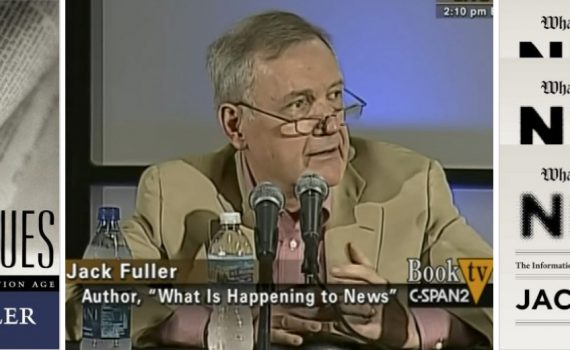
Sunday’s New York Times Book Review, for instance, held a highly complimentary review of Tom Bissell’s “Extra Lives: Why Video Games Matter.” In the Business section, Steven Johnson took mild exception to some of the premises in Nicholas Carr’s “The Shallows” in a piece called “Yes, People Still Read, but Now It’s Social.” And Carr’s busy blog, Rough Type, pointed me to the online version of the latest Nieman Reports, where Jack Fuller shares part of what he learned in researching and writing “What Is Happening to News” in a piece entitled “Feeling the Heat: The Brain Holds Clues for Journalism.” (Nieman also includes a link to Chapter 6 of the book, one of those I’ve been teaching at Medill this past academic year.)

In short, we’re long on discussion of the impact of technology on our cognitive abilities; of the continuing evolution of narrative; and of the changes wrought in and on our culture by the various media revolutions of the past 20 years. You can get a flavor by watching (all or some of) C-SPAN’s 47-minute video from Printers Row, available by clicking on the photo at right.

I can’t end this particular linkfest without doubling back yet again to the NYT and its magazine cover story Sunday about a computer system that has been built to play “Jeopardy!” The interactive simulation that accompanies the online version was nearly as compelling as the article … enough so that I didn’t get distracted while playing it (nor, come to think of it, was I distracted while reading. This is a good sign). Watching “Jeopardy!” today after having read the piece was to be reminded of just how tricky those clues really are, and what a feat of programming it is to “teach” a machine to parse them out.

The Brain

"The same thing we do every night, Pinky: Try to take over the world."

If I were so inclined, I suppose I could worry that by the time an IBM system is ready to have a real conversation with a human being, all the available humans will have, in Carr’s memorable construction, outsourced their memories to Google. For another day.

A day with Northwestern in Evanston

Friday, March 12th, 2010

So it has been a month since I last surfaced here, during which time my current graduate class, “How 21st Century Media Work,” has been driving steadily toward its conclusion: a discussion this coming Monday of Ken Auletta’s Googled: The End of the World as We Know It. Along the way, a clear highlight was the Monday where we held two moot court sessions, with teams of students assigned to argue different points of view on editorial outsourcing and on so-called* “paid content” strategies.

Schedule, A Day with Northwestern in Evanston 2010

Schedule, A Day with Northwestern in Evanston 2010

We pause in this rapidly concluding winter term to mention that I was asked to deliver a lecture at the annual “Day with Northwestern in Evanston” in April. Looks like, even if (especially if) you don’t want to listen to me, it’s a really interesting lineup of presenters, with keynotes by NU President Morton Schapiro and the jazz musician / NU professor Victor Goines.

The brochure says the committee looks for presenters with a “proven track record in the world at large, teaching ability, and relevance to today’s audience.”  Hope I can live up to that.

We now return to our regularly scheduled academic pursuits.


*All uses of “so-called” in The next miracle are dedicated to Jerome Holtzman, longtime dean of the nation’s baseball writers and legendary portable-computer student of mine, who used the so-called hyphenated adjective in 484 different Tribune stories between 1981 and 1999.

Don and Lou, and Lou and me

Monday, January 18th, 2010
Lou Grant meets the future of newspaper technology, 1977

Lou Grant meets the future of newspaper technology, 1977

My former Tribune colleague Don Terry, who is reporting these days for the Chicago News Cooperative, has written a feature for the Columbia Journalism Review in which he views the current state of the newspaper business partly through the prism of a 32-year-old television show. As you will have surmised from the headline and image above, that show is “Lou Grant,” which for five years gave viewers a whiff of both The Front Page and the front page.

“Lou Grant” is pretty much the last TV series I ever watched, other than the Steven Spielberg-produced cartoon “Animaniacs.” That I watched it at all was an accident of scheduling: it began airing on Tuesday nights, and I was off from my job in the sports slot on Mondays, Tuesdays, and Wednesdays. That I stayed with it was probably due to the fact that its depiction the fictional Los Angeles Tribune newsroom seemed to get a lot of things right, as I was reminded first by Don’s piece, then by going to Hulu to watch the premiere episode last night.

If you’re interested, it would be far more effective to get the flavor of “Lou” from Don’s piece than to have me recreate a sliver of it, so go there (and you certainly should go there before going to Hulu. Of course, you’d expect me to say that; after all, I downloaded a Hulu player in December of 2007 but had never even fired it up).  From the remove of 32-plus years, though, I was particularly struck by the image above.

Lou is waiting to interview with an old pal for a job that he doesn’t understand will be city editor of the Tribune. Asked to wait, he turns around and comes face to screen with one of those CRT’s that, before too long, would replace the clattering typewriters in the newsroom, but for then was sitting, blank and mute, on a table outside the managing editor’s office.  He pauses.  He bends over.  He reaches to tap its keyboard. (I can’t seem to tell if it’s a Harris or an Atex or an Ontel or some other animal entirely.  He can’t seem to tell if touching it will singe his fingertips.) He looks up at the ME’s secretary, grins sheepishly, and walks away from this “machine,” as he refers to it shortly thereafter.

Before long, in the tradition of large metro newspapers everywhere, he is ensconced at the city desk without the benefit of a moment’s further training beyond that which he brought in the door minutes earlier.  He doesn’t need to be schooled in using that ungainly box, because the skills of his trade are working the phone, smelling the news, and flipping an underreported, overwritten story back at a hotshot reporter.

The good news is, those skills are still important; they are not going to come and go like the ungainly, literally dumb terminal Lou was inspecting above. (Of course, you don’t need quite as supple a wrist for the flipping part as you used to, if you’re quick on the double-click.) I’m thinking I’ll be reminded of other skills not to forget when I fire up the Hulu desktop for Episode 2, perhaps even before another couple years have passed.

Was that a year? Well, it was 50 weeks of one.

Saturday, December 26th, 2009

There were still two weeks left to go until 2010, but on Dec. 17 I bravely joined Michael Miner of the Reader and Mark Fitzgerald of Editor & Publisher on Milt Rosenberg’s “Extension 720″ on WGN Radio to discuss the year in Chicago media.

If you are looking for two hours of background chatter as you organize gift receipts and packages for an afternoon of exchanging and refunding at the mall, you have come to the right place.

Extension 720 Uncut Podcast 12-17-09 Part 1 – WGN Radio.

Extension 720 Uncut Podcast 12-17-09 Part 2 – WGN Radio.

Not dead yet, but for how much longer?

Monday, November 30th, 2009

As I have mentioned here a couple of times, the students of the fall Interactive Innovation Project at Medill have been studying the past, assessing the present, and projecting the future of obituaries as a form of journalism and as a source of audience and revenue for publishers. Today on its Web site, obitresearch.com, the class released a white paper, “The State of the American Obituary,” that contains their findings.

They report that the central position that newspapers have held in communicating the news of Americans’ deaths is substantially threatened by changes in technology and audience behavior. Unlike other categories of aggregated listings, this is an area where newspapers today still retain a dominant market share.  In fact, Legacy.com Inc. – the Evanston-based aggregator of newspaper death notices that sponsored the research project, and where (disclosure) I am an independent board member – hosts death notices for 7 of every 10 Americans who die each year.

The class found that new user- and family-driven forms of remembering the dead, on social networking sites like Facebook and MySpace as well as standalone memorial sites and services, are attracting audience members who want not only to read about their friends and loved ones, but also to participate in their memorialization. While this began happening as soon as the first Web browsers appeared, the growth of social media, particularly among the Baby Boom generation, is causing an acceleration.

In preparing their report, the eight students who worked on this project conducted quantitative and qualitative surveys, reviewed scholarly and industry research, and conducted interviews with employees at newspapers nationwide. Based on their findings, they conclude with recommendations to media stakeholders on how to adapt to the many changes in the landscape of grieving, remembering and memorializing the dead.

You can download the report here. It was principally written and edited by Ashley Bates, Ian Monroe, and Ming Zhuang.  Contributing researchers were Jake Bressler, Alina Dain, Chris Deaton, Tiffany Glick, and Kate Goshorn.

Co-operative-etition, Chicago style

Tuesday, November 24th, 2009

The festival of links you can create these days when writing about new business models for the news industry is a wonder to behold. As we have noted here before, it seems sometimes there are almost as many conferences on the topic as there are stories about paid content, most of them involving Rupert Murdoch and/or Google.

Chicago News Cooperative logoOne prominent example, of course, is beginning to play out right here in Chicago: The Chicago News Cooperative launched last week, publishing two-page reports in the Friday and Sunday editions of the New York Times. I of course am watching with much interest, given that, by my count, I worked at the Tribune with around three-quarters of the 20 people named on the staff page today.

I suspect the Tribune and Sun-Times are watching with interest, too, given that the Tribune chose Sunday to publish another [not "the second" as originally reported--ORY] in a series of spadeas about its priorities (Capturing the Chicago Experience – click to download PDF, 3.44 mB). Its letter to readers from editor Gerry Kern ends, “We are Chicago’s newspaper. We tell your stories.”

(By my lights, the most remarkable thing about the Chicago News Cooperative example is that the NYT’s own journalists actually wrote about the launch. I guess that’s another example of how the world is changing; in the Olden Days, writing about anything your employer had done to try to improve its business prospects had a good chance to get you hooted out of any newsroom in America.)

But let’s not spend any more time here on background.  If you want more, read Alan Mutter’s piece at “Reflections of a Newsosaur” from earlier this month. Instead, let’s see what Chicago readers found in their driveways and newsstands Friday and Sunday morning, and not just in the NYT (using the acronym consistently today, to avoid confusion).

After all, CNC editor Jim O’Shea and his colleagues say they’re not out to supplant the existing newspapers; they are out to protect and sustain a kind of reporting they perceive as threatened, the public-service journalism “that we feel is crucial for a democracy . . . and provide accountability for the institutions and public officials in the city, county and state.” (Quote is from a WTTW interview with O’Shea, video after the jump.)

(more…)

Winter: A season for a few good books

Thursday, November 19th, 2009

Great Horned Owl

Great Horned Owl

Well, it was pretty exciting in Deerfield tonight, what with a Great Horned Owl calling from two blocks down the street at 8:45. Of course, the only reason I was outside to hear him was that I was straggling home from Northwestern at that hour, extracting my daily quota of catalogs from the mailbox.

And the reason I was straggling home was that I stayed in Evanston until I had more or less finalized a reading list for my winter class for graduate students. The winter term is almost as close as actual winter: It starts Jan. 4 at 9 a.m.

It’s the reading list work that has kept me away from blogging the last couple weeks:

  • The good news for me is that I worked my way through thousands of pages chock full of good ideas and trenchant observations, many of them published over just the past few weeks and months.
  • The good news for my students is that part of the exercise was identifying the absolutely most pertinent few pages in each of these books to assign to them.
  • And the even better news for me, my students, and the copyright holders is that my colleague Dr. Rachel Davis Mersey pointed me to a company, University Readers, that handles copyright clearances for book excerpts and then assembles them into a “course pack” that students can buy for a tiny fraction of the cost of that stack o’ books.

My nearly final draft of the syllabus begins this way:

The objectives of this course are

  • first, to reset the starting point from which students view both the craft and the business of journalism;
  • second, to familiarize students with the media industry and its rapidly changing practices in areas including business, operations, technology and content; and
  • third, to position students to capitalize on changes they encounter during their careers.

So, in order to accomplish that, what have I been reading?  After the jump, you will find a partial bibliography of my reading list.

41B7NrA03OL._SS500_Of course, some books are too interesting or important or trenchant or closely argued to be excerpted.  Such a book is the new Ken Auletta, Googled: The End of the World As We Know It. So alone among my recent readings, that’ll be one we peruse from beginning to end.

Owen's Wired collectionOne more observation:  Wired magazine remains tremendous.  Several recent pieces also made the cut, making me glad that I not only have maintained my subscription, but that I keep them handy on my office shelves.

At any rate, now it’s time to move on to the lectures and presentations.  But I sure have a lot of ideas in my head to play with.  Oh, and if you take the trouble to go to the jump and look at my recent reading, do me a favor:  If you see some recent book that I should be diving into, by all means let me know.

(more…)

Not dead yet (cont.)

Tuesday, November 3rd, 2009

Medill_logoAs I noted a month ago, this fall’s Interactive Innovation Project at Medill is an exploration of the state of the American obituary, and the eight graduate students with whom Rich Gordon and I are working are posting regularly on a blog at obitresearch.com.  There, I have recently learned

quite a bit more, including obituary practices at newspapers of different sizes.  And the class also has linked, each Friday, to a handful of interesting examples of obituaries and online memorials that run the gamut and then keep running.

The class’s final presentation isn’t till Dec. 10, so there is still lots more to learn.  Till then, I commend the site to your ongoing interest.