The next miracle (v11.1): Owen Youngman

Knight Professor of Digital Media Strategy, Medill / Northwestern

Owen YoungmanOwen YoungmanOwen Youngman

What was lost is found. But lost was fun, too.

404

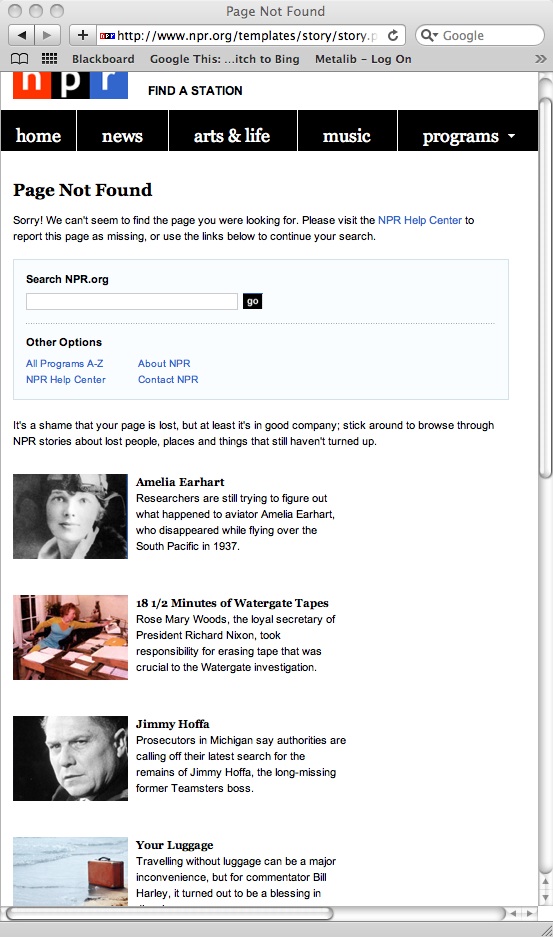
So you can't find your content? Maybe you'd like to read about something else that is lost. Like Amelia Earhart. Or your luggage.

Early this morning I was scanning my incoming Google alerts and found one I wanted to investigate at NPR.org. It was one of those funky links that breaks over about three lines and includes accidental carriage returns, however, so where I wound up was my favorite 404 page of all time: both funny and smart.

Sure, my content was lost.  Naturally I would want to read about lost content.

Naturally I tweeted it:

npr

To my extreme interest, it got retweeted quickly and often, and then re-retweeted, and re-re-retweeted, spreading virally just the way one would hope if it were actual journalism.

In fact, my bit.ly link to the bad URL got clicked on so much that somebody at NPR must have wondered why a specific nonexistent address got 450 clicks in a couple of hours … figured out where I had wanted to go … and fixed it. Wow, they know what to do about 404′s both on the front end and the back!

So everybody wins.  Other people actually looking to read about Marc-André Hamelin will get to.  Lots and lots of extra ads were served, even on those 404 pages.  Hundreds of people got an extra smile today.

And I learned that my own 404 page is an unexploited opportunity.

For now.

Lady Chatterley’s Twitter

Who ever thought a single newspaper would again be at the forefront of relevancy?  Goodness gracious, the Washington Post’s new social media guidelines have yet to be read by as many as 6 online pundits, and the world is rushing to catch up…

Bitter Tweet (chicagotribune.com via wires): Texas Tech bans tweeting after coach is dissed for being late to a meeting; Jets coach Mike Ryan benches David Clowney after coach is dissed for cutting his playint time on Sunday.

Bucks ban Twitter on team time (USA Today via wires): Ah, for the free-wheeling days when the decidedly ex-Buck Charlie Villanueva tweeted from the bench.

No-Tweet Heat (sun-sentinel.com): Like they said, Michael Beasley version.

NBA to unveil social media policy (ESPN.com): Enough of this freelancing already.  After all, it works for ESPN.

Oh, and while we are talking about military organizations:

Defense Department to Announce Social Media Policy” (emilitary.org, via NPR): “The problem now with social networking is that when you Twitter that information that might be sensitive … or put it on your Facebook page, thousands of people see it immediately, and then thousands more could see it as it’s forwarded on to others,” said the DoD’s “social network guy.”

Hmmm.  Wait a minute. Come to think of it, in the culture study conducted by the Readership Institute back in 2000, there were two industries that had cultures very similar to those of newspaper companies…..

Hospitals.  And the military.

Helps to explain things back at the WaPo, doesn’t it?

A festival of Twitter

TrendsMap: "Real-Time Local Twitter Trends"

TrendsMap: "Real-Time Local Twitter Trends"

A couple of weeks ago, on the NYT op-ed page, former ad executive James P. Othmer had some advice for President Obama: “Don’t Tweet About Health Care.” Well, that was the headline, anyway. The kicker was the slightly more nuanced “Here’s hoping that the next time Mr. Obama needs to deliver a complex idea, he’ll once again use more than 140 characters at a time.”

No way to tell if the president’s Twitter team was paying attention; there have been a few new healthcare tweets from @whitehouse to its 1.2 million followers since then, though most seem to be of the descriptive, not prescriptive variety.  But as most of the Twittersphere knows by now, apparently someone else who could have paid attention and didn’t was Washington Post managing editor Raju Narisetti, whose “personal” tweets about this and other topics were the proximate cause of a new WaPo policy severely limiting how its journalists deploy those limited-length thoughtlets. Not to mention whom they friend or discuss online. (Props to Staci D. Kramer (@sdkstl) – one of my favorite freelancers when I was the Tribune’s AME for business – for obtaining and publishing the guidelines on PaidContent.org.)

In his blog, “Pursuing the Complete Community Connection,” Steve Buttry of the Cedar Rapids Gazette (with whom I worked on the American Press Institute’s Newspaper Next project a few years ago) has a good summary of the fooferaw, some balanced reflections on the idea behind them, and some strong opinions on what appears to be wrong with them.  Fairly worthwhile way to start the morning if you were able to take the weekend off from reading and tweeting and blogging and such.

And the fact of the matter is, it probably would have been a good idea if you did.  Twitter exhaustion has not yet set in the investment community, given the company’s apparent $1 billion valuation last week. But as useful a tool as it appears to be, I am wondering if it’s really worthwhile to make sure I haven’t missed any of the 102 articles mentioning Twitter in the NYT this month.

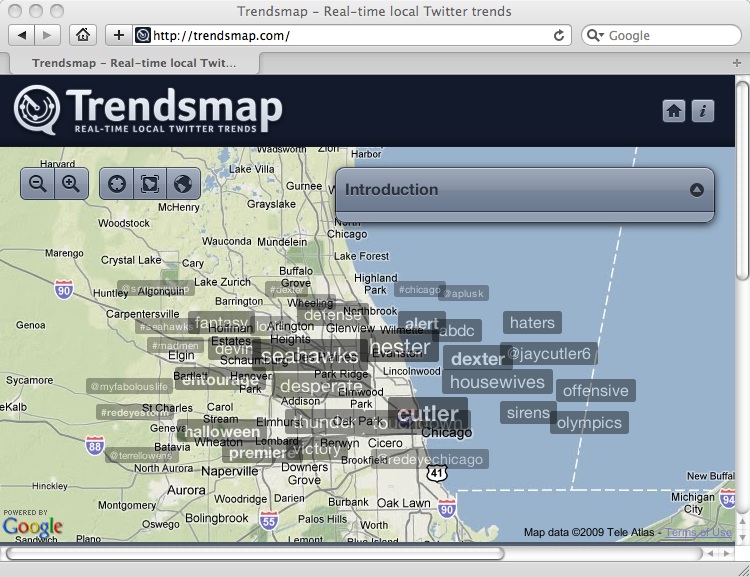
‘Tis a far, far better thing we do, perhaps, when we start exploring some of the remarkable things that programmers are doing with the Twitter API and a few other miracles.  That leads us to the map at the top of this post.  My old Tribune Interactive pal Carlos Barrionuevo pinged me on Facebook the other day to tell me about trendsmap.com by Stateless Systems. “Trendsmap.com is a real-time mapping of Twitter trends across the world. See what the global, collective mass of humanity are discussing right now,” says the Web site. Actually, you don’t have to be content just to see what topics are trending; you can drill down on any box and see the tweets flash by.

Chicago-area Trendsmap from Sunday night

Today being Sunday (well, it was Sunday when I started writing), there were a heck of a lot of NFL team nicknames in large, easy-to-read type.  Zooming in on the Chicago area (click on image at right to enlarge) brought additional granularity: hester, cutler, jaycutler6, touchdown. When I played with this on Friday morning, there were big stacks o’ tweets about “Paranormal” in all the cities where it had been screened the night before.

“In the last two days I have found real time info on two events before the local/national media reported it,” Carlos told me. “Really scary what true crowdsourcing can produce.”

Scary or no, it’s these apps that probably give Twitter much of its potential for staying power, even as the nattering about its lack of a revenue model percolates away.  Later Friday Mashable ran another one of those Hitwise charts indicating that traffic to Twitter.com may be plateauing, after a year in which its growth ranged between, oh, 422% and 1382%.

But, once again, wait a minute.  People build enough of these interesting sites that tell you something about the world, as opposed to just showing you the tweets, and you know what?  You might be nuts to go back to Twitter.com except to change your background image.

Or to learn about health care, half a thought at a time.

ADD END: What, you don’t think this is such a festival?  Here, let’s allow Mashable to help.  Posted this morning: 10 Hilarious Twitter Parody Videos, including a “tutorial” from the Onion on stalking your kids via Facebook and Twitter.