Archive for March, 2009

Poisson d’avril, take 2 [Google]

Tuesday, March 31st, 2009
Cognitive Autoheuristic Distributed-Intelligence Entity

Cognitive Autoheuristic Distributed-Intelligence Entity


Happy April 1 from Google:


Introducing CADIE

Technical specifications

CADIE’s personal World Wide Website

Gmail Autopilot by CADIE

Poisson d’avril! [Guardian]

Tuesday, March 31st, 2009

Some of my Twitterfied friends took this literally, not noticing that when it showed up online here in the U.S., it was already April 1 across the pond.  Anyway, the tone is just right.

Twitter switch for Guardian, after 188 years of ink | Media | The Guardian .

The pasture is prologue

Saturday, March 28th, 2009

app_full_proxyphpMonday is the first day of the spring term at Northwestern.  It will have been four months, exactly, since I went out to pasture after 37 years at Tribune Tower.

There has been a lot to think about, watching the news industry from the outside since Thanksgiving.  Ultimately, I suspect educators and entrepreneurs together will have to come up with the tools and the ideas that help news professionals sustain not only journalism, but also the kind of society that wants or needs journalism.

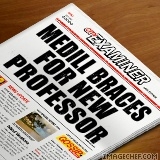
And so, off to the Medill School of Journalism I go.  One miracle at a time.

whitehousechatroom.gov, then and now

Friday, March 27th, 2009

How Times Have Changed [Or Not] In Response to New Media, installment 14,441:

  • Obama explaining why he decided to have a live Internet video chat:

 “This is an experiment,” the president said in a video promoting the event, “but it’s also an exciting opportunity for me to look at a computer and get a snapshot of what Americans across the country care about.”

(via Obama Makes History in Live Internet Video Chat – NYTimes.com.)

  • FDR explaining why he decided to have a live radio “fireside chat,” on the subject of the banking system (from the New York Times of March 12, 1933, in advance of the 10 p.m. address that evening):

The President said that the Constitution laid upon him the duty of reporting to Congress assembled in Washington the condition of the country, and he believed he had a like duty to convey to the people themselves a clear picture of the situation at the national capital “whenever there is danger of any confusion as to what the government is undertaking.”


I got a pal in Kalamazoo. Several more than before, in fact

Thursday, March 26th, 2009
Murray Perahia [Ismael Roldan, WSJ]Murray Perahia (Ismael Roldan, WSJ)

We were in Kalamazoo tonight to hear the pianist Murray Perahia play a monster recital that included Beethoven’s Appassionata Sonata and concluded with Brahms’ “Variations on a Theme by Handel.”  As it happens, the Journal ran an interview with him in this morning’s paper; quotes like the following should have set me up for how good the Brahms would be, but I still was unprepared…..

“I love how with the fewest notes, Brahms has the greatest effect,” Mr. Perahia said. “Every note speaks to him like a world.”

via Pianist’s Passions: Constant, Recent and Renewed – WSJ.com.

Equally rewarding were our conversations with the people of Kalamazoo … not just those associated with the Gilmore Keyboard Festival (executive director Daniel Gustin, Facebook friend and development director Alice Kemerling), which staged the event, but – as they overheard we were from Chicago – people in the crowd we’d never met. We even were greeted by Bill Richardson, former president and CEO of the Kellogg Foundation, whose major gift to the Gilmore endowed this concert. 

They struck up  conversations about a wide variety of topics, including the fates of newspapers like the Ann Arbor News and their own Grand Rapids Press; the theoretical boundaries of “Chicagoland”; and, of course, music.

The next full Gilmore International Keyboard Festival is scheduled for April 23 to May 9, 2010, with the lineup to be announced on Sept. 13.  I imagine we’ll be there, one way or another.  Oh, and don’t just sit there; become a fan of the Gilmore on Facebook yourself!

Ask a Flowchart: Which Blowhard Am I? [Wired]

Wednesday, March 25th, 2009

As I was shelving 16-plus years of Wired magazines on the shelves in my office at Medill today, I saw plenty of memorable cover stories … and, in some remarkably thick back numbers from the late 1990s, plenty of evidence of memorable ads for forgotten Internet startups. Rather than be nostalgic, however, here’s a cheerful graphic from issue 17.04.

Ask a Flowchart: Which Blowhard Am I? .

(Oh, why do I still have the dead-trees editions, you ask? Well, when I remember a long story to which I want to refer, it’s actually easier to search for it on wired.com, then pull the actual issue off the shelf. With the bonus that I generally get to see some of those remarkable pre-bust ads.)

(Bonus No. 2: it’s a very colorful way to brighten up a wall of bookcases.)

Back at the scene

Monday, March 23rd, 2009

Last Thursday I was at the corner of Chicago and Dempster in Evanston to meet a couple of Medill undergrads at Starbucks.  They have asked me to serve as adviser for their summer project, which I won’t reveal here but which manages to combine my interests in social media, economic news, and cold, windswept climates.

It was September, 1974, and I was heading back to school after buying a birthday gift at the Practical Tiger in Evanston.  I remember it as a watering can.  Anyway, the car radio was loud, and as I sailed into the intersection of Chicago and Dempster, I was broadsided by an Evanston police car, lights flashing (and, evidently, siren wailing).

The cop wasn’t happy, and I soon was summoned to court.  And summoned, and summoned, because the cop also seemed too busy to appear and the City of Evanston kept getting continuances… (more…)

Growing Up on Facebook [NYT Mag]

Friday, March 20th, 2009


Time spent on FB by age cohort (NYT)

Time spent on FB by age cohort (NYT)


Well, apparently there’s a new reason to fret about social networks.  Will they eliminate teen-agers’ incentive, and opportunity, to grow up?


“For all the discussion Facebook has prompted, its most profound impact may be to alter, even obliterate, conventional notions of the past, to change the way young people become adults.  … [S]omething is drowned in that virtual coffee cup — an opportunity for insight, for growth through loneliness.”

via The Way We Live Now – Growing Up on Facebook – NYTimes.com.