The next miracle (v11.1): Owen Youngman

Knight Professor of Digital Media Strategy, Medill / Northwestern

Owen YoungmanOwen YoungmanOwen Youngman

This is your brain. This is your brain on Twitter.

My colleague Ellen Shearer posted a link to the Medill faculty listserv yesterday  about a recent academic study in Scotland with a headline-grabbing conclusion.  In fact, let me quote the headline from the Telegraph:

Facebook ‘enhances intelligence’ but Twitter ‘diminishes it’, claims psychologist

Dr. Tracy Alloway, from the University of Stirling in Scotland, did the study with 11- to 14-year-olds. It indicates that, more specifically,

Playing video war games and solving Sudoku may have the same effect as keeping up to date with Facebook . . . But text messaging, micro-blogging on Twitter and watching YouTube were all likely to weaken ”working memory.”

”On Twitter you receive an endless stream of information, but it’s also very succinct,” said Dr. Alloway. ”You don’t have to process that information. Your attention span is being reduced and you’re not engaging your brain and improving nerve connections.”

This matter of how the brain processes information is of great interest to many people. One of them is my former Tribune boss Jack Fuller, who in fact has devoted the last several years to this topic himself, particularly to the piece that explores how people absorb and understand news. Indeed, he has a book coming out next April from the University of Chicago, What Has Been Happening to News, that explores the topic in depth.

He allowed me to read it in typescript, and I won’t steal of any of its thunder now.  But more than two years ago, in a Tribune Perspective piece entitled “Reasoning With Feeling: Boosters of the Internet see it as a perfect forum for reasoned debate. But neuroscience tells us that emotions keep popping up,” he began to explore what he was learning.

Neuroscience came into its own at about the same time the Internet did. In the past couple decades, new techniques for peering into brain processes haveled to extraordinary advances in understanding the mind. These have profoundly refigured the picture that came down to us from philosophers and early generations of psychologists.

One area is particularly fascinating: The new model of the mind offers important but unsettling insights into why people respond to today’s media as they do.

The archived piece is worth a spin (though the parser that put it up on the Tribune archive site does a lousy job with word spacing every 80 characters or so). Essentially, Jack is exploring a different issue than the Scottish researcher: not the diminishment of intelligence, but the primacy of emotion “[w]hen the brain is challenged to process very difficult information – let’s say, multitasking amid an overload of information.”

Come the spring, you will want to read Jack’s book.  In the meantime, however, I guess I will feel good that I spend more time on Facebook than either Twitter or YouTube.

Though you could argue it might be a better demonstration of intelligence, diminishing or otherwise, to spend less time with both.

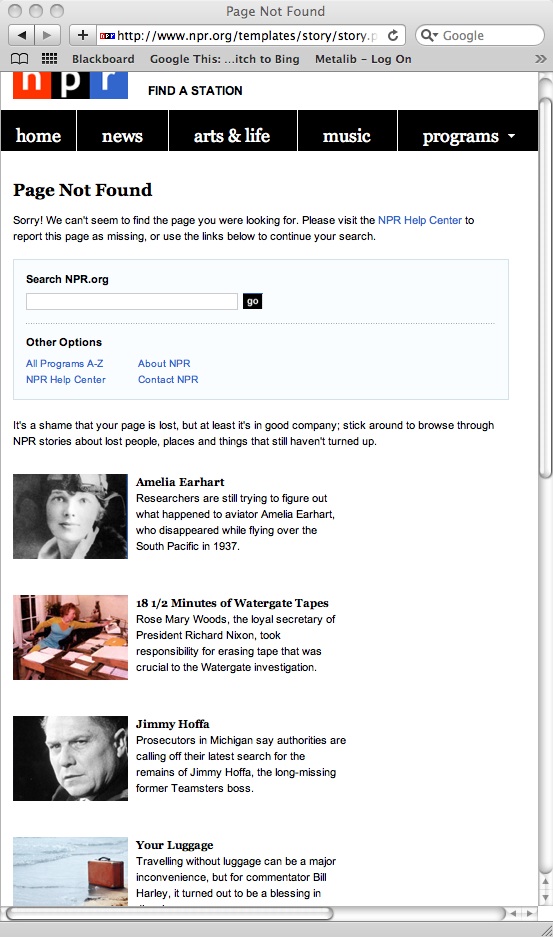
What was lost is found. But lost was fun, too.

404

So you can't find your content? Maybe you'd like to read about something else that is lost. Like Amelia Earhart. Or your luggage.

Early this morning I was scanning my incoming Google alerts and found one I wanted to investigate at NPR.org. It was one of those funky links that breaks over about three lines and includes accidental carriage returns, however, so where I wound up was my favorite 404 page of all time: both funny and smart.

Sure, my content was lost.  Naturally I would want to read about lost content.

Naturally I tweeted it:

npr

To my extreme interest, it got retweeted quickly and often, and then re-retweeted, and re-re-retweeted, spreading virally just the way one would hope if it were actual journalism.

In fact, my bit.ly link to the bad URL got clicked on so much that somebody at NPR must have wondered why a specific nonexistent address got 450 clicks in a couple of hours … figured out where I had wanted to go … and fixed it. Wow, they know what to do about 404′s both on the front end and the back!

So everybody wins.  Other people actually looking to read about Marc-André Hamelin will get to.  Lots and lots of extra ads were served, even on those 404 pages.  Hundreds of people got an extra smile today.

And I learned that my own 404 page is an unexploited opportunity.

For now.

Lady Chatterley’s Twitter

Who ever thought a single newspaper would again be at the forefront of relevancy?  Goodness gracious, the Washington Post’s new social media guidelines have yet to be read by as many as 6 online pundits, and the world is rushing to catch up…

Bitter Tweet (chicagotribune.com via wires): Texas Tech bans tweeting after coach is dissed for being late to a meeting; Jets coach Mike Ryan benches David Clowney after coach is dissed for cutting his playint time on Sunday.

Bucks ban Twitter on team time (USA Today via wires): Ah, for the free-wheeling days when the decidedly ex-Buck Charlie Villanueva tweeted from the bench.

No-Tweet Heat (sun-sentinel.com): Like they said, Michael Beasley version.

NBA to unveil social media policy (ESPN.com): Enough of this freelancing already.  After all, it works for ESPN.

Oh, and while we are talking about military organizations:

Defense Department to Announce Social Media Policy” (emilitary.org, via NPR): “The problem now with social networking is that when you Twitter that information that might be sensitive … or put it on your Facebook page, thousands of people see it immediately, and then thousands more could see it as it’s forwarded on to others,” said the DoD’s “social network guy.”

Hmmm.  Wait a minute. Come to think of it, in the culture study conducted by the Readership Institute back in 2000, there were two industries that had cultures very similar to those of newspaper companies…..

Hospitals.  And the military.

Helps to explain things back at the WaPo, doesn’t it?