Posts Tagged ‘Social networks’

The technological octogenarian

Sunday, February 7th, 2010
A man, a plan, a canal ... er, an iPhone and Facebook.

A man, a plan, a canal ... er, an iPhone and Facebook.

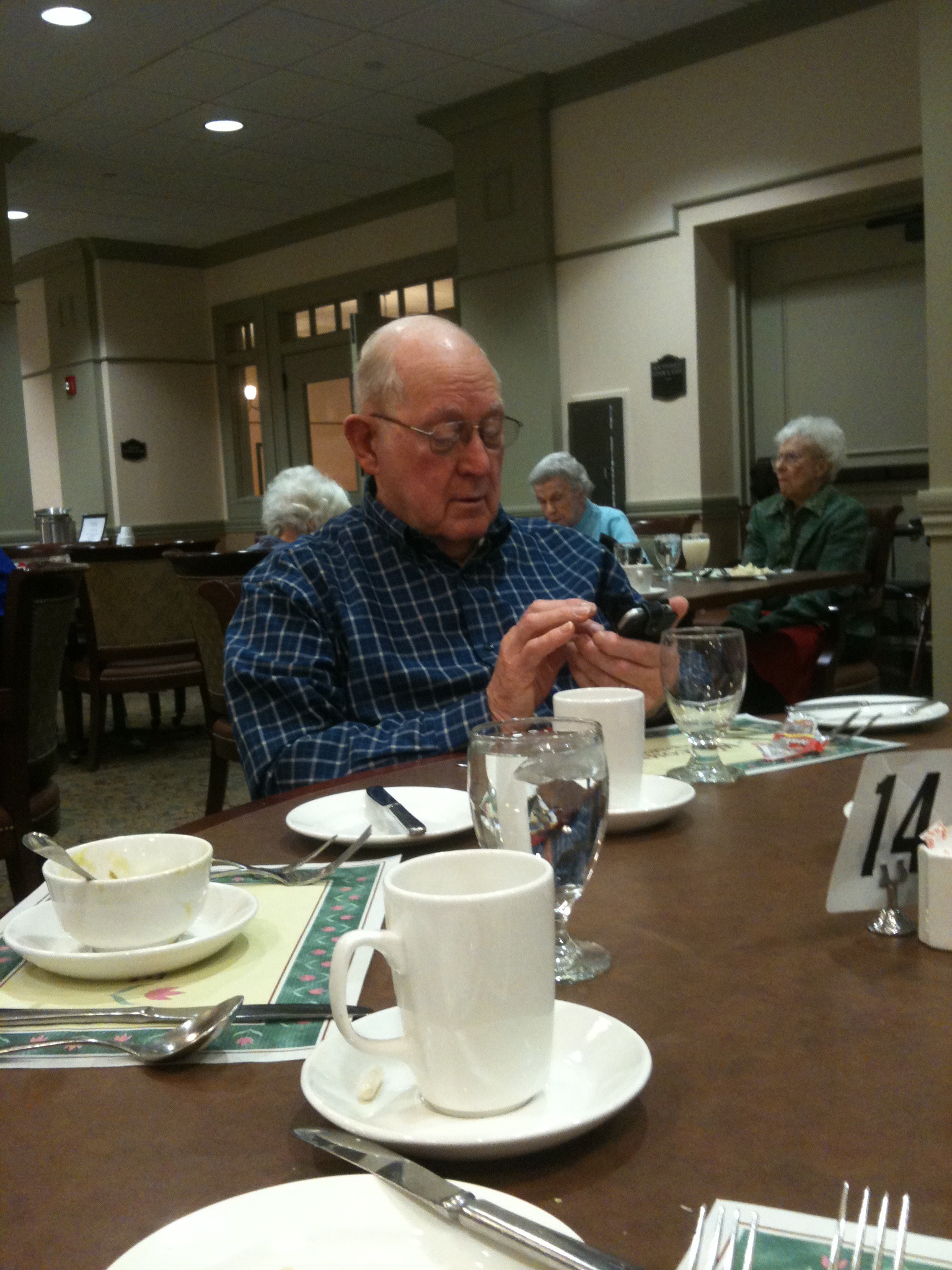
My father turned 80 on Saturday, and my sister and I and our spouses went out to The Holmstad, my parents’ retirement community in Batavia, for the occasion. Shortly after 5, we were in the Holmstad dining room, the 6 of us armed with our 5 iPhones and high expectations for a festive meal.

Festive meals can, of course, take a while to arrive; so, as photo opportunities go, the one at right was way easier to seize than most. When I grabbed this image with my iPhone camera, I suspected that all I had to do was write the right caption, upload it to Facebook, and wait for my thousand or so Facebook friends to decide if they, too, found it interesting.

“Dad checks Facebook on his iPhone while waiting for 80th birthday dinner to arrive….”

It was just a few minutes after 5 p.m. By the time we got home from Symphony Center (where we went after the birthday bash ended), it had more interaction than any other single thing I’d ever posted on Facebook. “Awesome,” wrote Don. “Dad rocks,” noted Marie. “So that’s the old block off of which you are a chip,” observed Eric.

And then there were all the folks merely clicking Facebook’s thumbs-up “Like” icon. It should be noted that many of them don’t even know him!

It had already been a big day online in Owen World; a very complimentary link from Scot McKnight’s popular beliefnet.com blog, “Jesus Creed,” was sending my Feb. 27 essay on past and future literary artifacts into the top 5 of my posts over the last year. (Scot drove about 4% of my overall traffic in 2009, and at this rate he’s going to achieve his tongue-in-cheek goal of sending me more readers than does Northwestern.)

So is an octogenarian iPhone-ing Facebooker really all that noteworthy? As Linda observed at home tonight, people born in 1930 have had to adapt to changes that are in many ways more dramatic and less incremental then any of us younger whippersnappers. Television, for one. Church-run retirement homes with waitstaffs and Starbucks counters, for two.

So what are you waiting for, gentle readers? Get your dads and moms their own smart phones and social network accounts. And then send them to owenyoungman.com.

Happy birthday, Dad.

Not dead yet, but for how much longer?

Monday, November 30th, 2009

As I have mentioned here a couple of times, the students of the fall Interactive Innovation Project at Medill have been studying the past, assessing the present, and projecting the future of obituaries as a form of journalism and as a source of audience and revenue for publishers. Today on its Web site, obitresearch.com, the class released a white paper, “The State of the American Obituary,” that contains their findings.

They report that the central position that newspapers have held in communicating the news of Americans’ deaths is substantially threatened by changes in technology and audience behavior. Unlike other categories of aggregated listings, this is an area where newspapers today still retain a dominant market share.  In fact, Legacy.com Inc. – the Evanston-based aggregator of newspaper death notices that sponsored the research project, and where (disclosure) I am an independent board member – hosts death notices for 7 of every 10 Americans who die each year.
The class found that new user- and family-driven forms of remembering the dead, on social networking sites like Facebook and MySpace as well as standalone memorial sites and services, are attracting audience members who want not only to read about their friends and loved ones, but also to participate in their memorialization. While this began happening as soon as the first Web browsers appeared, the growth of social media, particularly among the Baby Boom generation, is causing an acceleration.

In preparing their report, the eight students who worked on this project conducted quantitative and qualitative surveys, reviewed scholarly and industry research, and conducted interviews with employees at newspapers nationwide. Based on their findings, they conclude with recommendations to media stakeholders on how to adapt to the many changes in the landscape of grieving, remembering and memorializing the dead.

You can download the report here. It was principally written and edited by Ashley Bates, Ian Monroe, and Ming Zhuang.  Contributing researchers were Jake Bressler, Alina Dain, Chris Deaton, Tiffany Glick, and Kate Goshorn.

This is your brain. This is your brain on Twitter.

Thursday, October 1st, 2009

My colleague Ellen Shearer posted a link to the Medill faculty listserv yesterday  about a recent academic study in Scotland with a headline-grabbing conclusion.  In fact, let me quote the headline from the Telegraph:

Facebook ‘enhances intelligence’ but Twitter ‘diminishes it’, claims psychologist

Dr. Tracy Alloway, from the University of Stirling in Scotland, did the study with 11- to 14-year-olds. It indicates that, more specifically,

Playing video war games and solving Sudoku may have the same effect as keeping up to date with Facebook . . . But text messaging, micro-blogging on Twitter and watching YouTube were all likely to weaken ”working memory.”

”On Twitter you receive an endless stream of information, but it’s also very succinct,” said Dr. Alloway. ”You don’t have to process that information. Your attention span is being reduced and you’re not engaging your brain and improving nerve connections.”

This matter of how the brain processes information is of great interest to many people. One of them is my former Tribune boss Jack Fuller, who in fact has devoted the last several years to this topic himself, particularly to the piece that explores how people absorb and understand news. Indeed, he has a book coming out next April from the University of Chicago, What Has Been Happening to News, that explores the topic in depth.

He allowed me to read it in typescript, and I won’t steal of any of its thunder now.  But more than two years ago, in a Tribune Perspective piece entitled “Reasoning With Feeling: Boosters of the Internet see it as a perfect forum for reasoned debate. But neuroscience tells us that emotions keep popping up,” he began to explore what he was learning.

Neuroscience came into its own at about the same time the Internet did. In the past couple decades, new techniques for peering into brain processes haveled to extraordinary advances in understanding the mind. These have profoundly refigured the picture that came down to us from philosophers and early generations of psychologists.

One area is particularly fascinating: The new model of the mind offers important but unsettling insights into why people respond to today’s media as they do.

The archived piece is worth a spin (though the parser that put it up on the Tribune archive site does a lousy job with word spacing every 80 characters or so). Essentially, Jack is exploring a different issue than the Scottish researcher: not the diminishment of intelligence, but the primacy of emotion “[w]hen the brain is challenged to process very difficult information – let’s say, multitasking amid an overload of information.”

Come the spring, you will want to read Jack’s book.  In the meantime, however, I guess I will feel good that I spend more time on Facebook than either Twitter or YouTube.

Though you could argue it might be a better demonstration of intelligence, diminishing or otherwise, to spend less time with both.

Lady Chatterley’s Twitter

Tuesday, September 29th, 2009

Who ever thought a single newspaper would again be at the forefront of relevancy?  Goodness gracious, the Washington Post’s new social media guidelines have yet to be read by as many as 6 online pundits, and the world is rushing to catch up…

Bitter Tweet (chicagotribune.com via wires): Texas Tech bans tweeting after coach is dissed for being late to a meeting; Jets coach Mike Ryan benches David Clowney after coach is dissed for cutting his playint time on Sunday.

Bucks ban Twitter on team time (USA Today via wires): Ah, for the free-wheeling days when the decidedly ex-Buck Charlie Villanueva tweeted from the bench.

No-Tweet Heat (sun-sentinel.com): Like they said, Michael Beasley version.

NBA to unveil social media policy (ESPN.com): Enough of this freelancing already.  After all, it works for ESPN.

Oh, and while we are talking about military organizations:

Defense Department to Announce Social Media Policy” (emilitary.org, via NPR): “The problem now with social networking is that when you Twitter that information that might be sensitive … or put it on your Facebook page, thousands of people see it immediately, and then thousands more could see it as it’s forwarded on to others,” said the DoD’s “social network guy.”

Hmmm.  Wait a minute. Come to think of it, in the culture study conducted by the Readership Institute back in 2000, there were two industries that had cultures very similar to those of newspaper companies…..

Hospitals.  And the military.

Helps to explain things back at the WaPo, doesn’t it?

A festival of Twitter

Monday, September 28th, 2009
TrendsMap: "Real-Time Local Twitter Trends"

TrendsMap: "Real-Time Local Twitter Trends"

A couple of weeks ago, on the NYT op-ed page, former ad executive James P. Othmer had some advice for President Obama: “Don’t Tweet About Health Care.” Well, that was the headline, anyway. The kicker was the slightly more nuanced “Here’s hoping that the next time Mr. Obama needs to deliver a complex idea, he’ll once again use more than 140 characters at a time.”

No way to tell if the president’s Twitter team was paying attention; there have been a few new healthcare tweets from @whitehouse to its 1.2 million followers since then, though most seem to be of the descriptive, not prescriptive variety.  But as most of the Twittersphere knows by now, apparently someone else who could have paid attention and didn’t was Washington Post managing editor Raju Narisetti, whose “personal” tweets about this and other topics were the proximate cause of a new WaPo policy severely limiting how its journalists deploy those limited-length thoughtlets. Not to mention whom they friend or discuss online. (Props to Staci D. Kramer (@sdkstl) – one of my favorite freelancers when I was the Tribune’s AME for business – for obtaining and publishing the guidelines on PaidContent.org.)

In his blog, “Pursuing the Complete Community Connection,” Steve Buttry of the Cedar Rapids Gazette (with whom I worked on the American Press Institute’s Newspaper Next project a few years ago) has a good summary of the fooferaw, some balanced reflections on the idea behind them, and some strong opinions on what appears to be wrong with them.  Fairly worthwhile way to start the morning if you were able to take the weekend off from reading and tweeting and blogging and such.

And the fact of the matter is, it probably would have been a good idea if you did.  Twitter exhaustion has not yet set in the investment community, given the company’s apparent $1 billion valuation last week. But as useful a tool as it appears to be, I am wondering if it’s really worthwhile to make sure I haven’t missed any of the 102 articles mentioning Twitter in the NYT this month.

‘Tis a far, far better thing we do, perhaps, when we start exploring some of the remarkable things that programmers are doing with the Twitter API and a few other miracles.  That leads us to the map at the top of this post.  My old Tribune Interactive pal Carlos Barrionuevo pinged me on Facebook the other day to tell me about trendsmap.com by Stateless Systems. “Trendsmap.com is a real-time mapping of Twitter trends across the world. See what the global, collective mass of humanity are discussing right now,” says the Web site. Actually, you don’t have to be content just to see what topics are trending; you can drill down on any box and see the tweets flash by.

Chicago-area Trendsmap from Sunday night

Today being Sunday (well, it was Sunday when I started writing), there were a heck of a lot of NFL team nicknames in large, easy-to-read type.  Zooming in on the Chicago area (click on image at right to enlarge) brought additional granularity: hester, cutler, jaycutler6, touchdown. When I played with this on Friday morning, there were big stacks o’ tweets about “Paranormal” in all the cities where it had been screened the night before.

“In the last two days I have found real time info on two events before the local/national media reported it,” Carlos told me. “Really scary what true crowdsourcing can produce.”

Scary or no, it’s these apps that probably give Twitter much of its potential for staying power, even as the nattering about its lack of a revenue model percolates away.  Later Friday Mashable ran another one of those Hitwise charts indicating that traffic to Twitter.com may be plateauing, after a year in which its growth ranged between, oh, 422% and 1382%.

But, once again, wait a minute.  People build enough of these interesting sites that tell you something about the world, as opposed to just showing you the tweets, and you know what?  You might be nuts to go back to Twitter.com except to change your background image.

Or to learn about health care, half a thought at a time.

ADD END: What, you don’t think this is such a festival?  Here, let’s allow Mashable to help.  Posted this morning: 10 Hilarious Twitter Parody Videos, including a “tutorial” from the Onion on stalking your kids via Facebook and Twitter.

Growing Up on Facebook [NYT Mag]

Friday, March 20th, 2009


Time spent on FB by age cohort (NYT)

Time spent on FB by age cohort (NYT)


Well, apparently there’s a new reason to fret about social networks.  Will they eliminate teen-agers’ incentive, and opportunity, to grow up?


“For all the discussion Facebook has prompted, its most profound impact may be to alter, even obliterate, conventional notions of the past, to change the way young people become adults.  … [S]omething is drowned in that virtual coffee cup — an opportunity for insight, for growth through loneliness.”

via The Way We Live Now – Growing Up on Facebook – NYTimes.com.