Posts Tagged ‘Kindle’

It’s an e-reader! No, it’s a tablet! No, it’s . . . a means to an end

Sunday, December 27th, 2009

a30_businessIt seems that one of the questions I got asked most frequently in 2009 – at weddings, in email, in the church narthex, at Northwestern – was some version of “Should I get a Kindle?”  Even people who aren’t sure assume that I have one (and indeed, thanks to the generosity of friends, I have a couple).

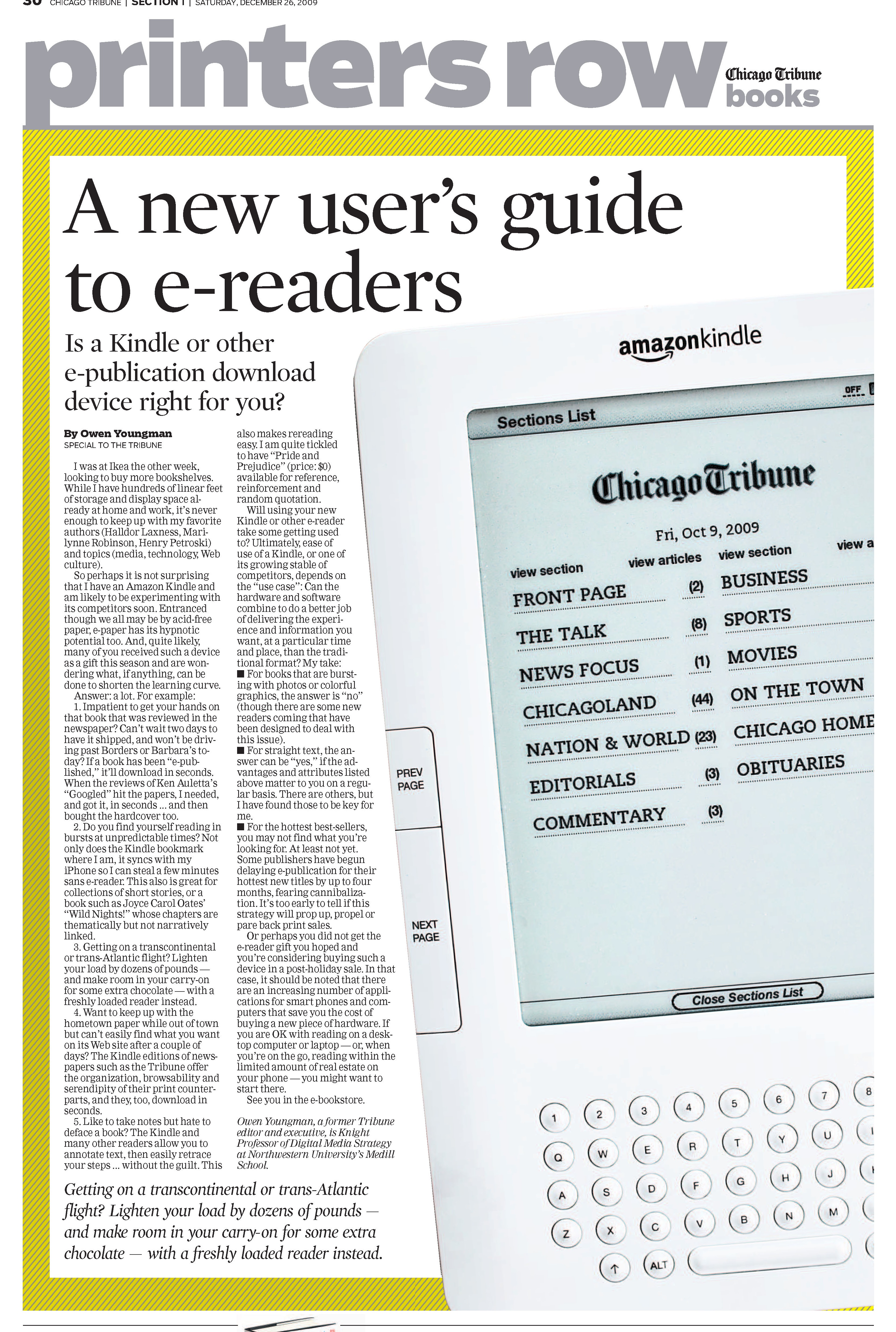
The most recent version of the query came from Tribune literary editor Liz Taylor, who wondered if I could write a piece for the Printers Row pages of the Saturday Tribune on “why you use it, and maybe some tips . . . but as a WORD person, who loves books no matter what the form.” Well, sure. You can see the result, from the Dec. 26 edition, here.

Meanwhile, it seems that there were nearly as many articles on e-readers published this Christmas season as there were books to consume on them.  Christmas morning, for instance, the Trib business section reported on shortages and / or delayed launches of several Kindle competitors; on Christmas Eve morning the NYT’s “Bits” blog used an interview with Jeff Bezos and some data mining of customer comments to lay out a reason why all those competitors were rushing to get into the market.  It’s getting to the point that covering e-readers is like covering presidential politics: lots of focus on the horse race, very little on either the technology or the use case.

Which is why I probably enjoyed the Economist’s Dec. 12th piece, “Read all about it,” more than most.  It’s mostly about the display technology behind the readers; as the piece’s pullout summary puts it, “Readers of electronic books must choose between long battery life or vibrant, living colour. Could they have both?”  This is the place to go if you want to read about choleristic LCD’s and electophoretic displays, among other contenders to provide an answer to that question . . . while responsibly pointing out that “in the history of ingenious display technologies, only a handful have ever made it into mass production.”

(more…)

A by-the-book reader meets the Kindle (NYT)

Saturday, May 30th, 2009

The slim, envelope-size Kindle is undeniably convenient, even for the curmudgeonly. – Picture caption from  By-the-Book Reader Meets the Kindle – NYTimes.com.

==

This first-person article about the accommodations that even a “curmudgeon” is willing to make when the technology is good enough, and the use case is right, to me is another confirmation of my hypothesis that the Kindle is showing the way toward a future in which people get paid for the content they are able to deliver conveniently (emphasis most emphatically mine).  ’Nuff said; go read it.

Adventures in paid content, with actual payment

Thursday, May 21st, 2009
The check was in the mail.  I didn't cash it, however.

The check was in the mail. I didn't cash it, however.

Drowned out in the buzz about the yet-to-appear Kindle DX a couple of weeks ago was the semi-related announcement that Amazon was opening the gates of remunerated e-publishing not only to newspapers and magazines, but to everyday bloggers.  Among the first to “sell out,” as he headlined it, was my industry colleague Steve Yelvington, who blogs at yelvington.com.

Yes, you now can pay a monthly fee to Amazon.com not just to read the New York Times or LA Times or Chicago Tribune on your current and future Kindle.  You also can pay them to get yelvington.com, although  ”I don’t know whether anyone will buy it (and I have my doubts, since the idiot who manages this operation gives away the same content on the Web),” he noted.

Well, us journalist types at the end of the alphabet need to stick together. So as of today version 11.0 of “The next miracle” is also available in a Kindle edition (is that version 11.1?), and the low monthly price of $1.99 “includes wireless delivery via Amazon Whispernet.”

Line up, sign up, subscribe today.

Plus, “Kindle Blogs are auto-delivered wirelessly to your Kindle and updated throughout the day so you can stay current.”

Plus plus, “It’s risk free—all Kindle Blog subscriptions start with a 14-day free trial. You can cancel at any time during the free trial period. If you enjoy your subscription, do nothing and it will automatically continue at the regular monthly price.”

Plus plus plus, I already know how to make money on the Internet!  Just look at the check at the top of this post!

Yes, in early 2000, I succumbed to another e-publishing siren song.  I signed up with MightyWords.com, which billed itself as ”a definitive digital marketplace for the written word.” According to Library Journal, MightyWords, which was launched by the evocatively named Fatbrain.com, “offers authors and publishers a new digital channel to read, write, buy, and sell written content, including essays, short stories, chapters, and additional works.”

“By creating the first digital marketplace to read, write, buy, and sell ideas, MightyWords will unleash a wealth of written content and will create a powerful distribution channel that will significantly affect the publishing world,” said Chris MacAskill, Fatbrain.com CEO. Well, who could resist?  Not me.  Even though it was available for free here at owenyoungman.com, I uploaded my 1997 travel essay “From Hong Kong to Hershey:  Or, I Liked the Thick Chocolate Shake More Than the Thick Soup of Snake” and waited for the royalties to roll in.

(more…)

Kindling

Wednesday, May 6th, 2009
The Kindle DX

The Kindle DX

No shortage of coverage of today’s announcement, telegraphed in the NYT on Monday, of a new, larger Kindle from Amazon:

  • Matt Mansfield of Medill points out this good comparison with the Plastic Logic eReader at PaidContent.org, for instance.
  • Commenters at several sites, including the NYT, point out that while this new Kindle costs as much as some laptops, it includes free wireless access, use of which is not limited to downloading books, magazines, and newspapers.
  • And I even got into the act (video link), appearing on CBS2Chicago.  My points are similar to those I made in an April 11 post here on owenyoungman.com about the Kindle 2:
  • There is a lot to like already about the Kindle as a platform for magazine and newspaper content, but I haven’t read much about the reason I think it works, and is worth paying for: unlike the Web sites of most newspapers, the Kindle preserves a key newspaper-reading experience: Serendipity. [Read the whole post]

I talked more about that today, as well as a point I also made this past Monday when I spoke in New York on a Medill-sponsored panel, “Managing in a Time of Crisis and Opportunities”: Implementations like the Kindle help to demonstrate that even if people aren’t much paying for news content today, they ultimately are likely to pay for content that is tailored to their needs, their use cases, and experiences they value.  Publishers need to pay attention to that, not to eking out micropayments on yesterday’s platforms.

I may yet double back on Monday’s presentation, but for now suffice it to say that nothing I saw about the new Kindle today made me any less cheerful, except perhaps the price.  And I’m cheerfully hoping it comes down soon, for others’  sake if not my own.

Serendipity regained (WSJ.com)

Saturday, April 11th, 2009

Amazon.com Inc. is developing a new version of its Kindle electronic-book reader featuring a larger screen, according to people who said they have seen a version of the device. . . .The move could help Amazon better compete for the business of newspaper and magazine publishers looking for new distribution platforms for digital content.

via Amazon Is Developing Bigger-Screen Kindle – WSJ.com.

There is a lot to like already about the Kindle as a platform for magazine and newspaper content, but I haven’t read much about the reason I think it works, and is worth paying for: unlike the Web sites of most newspapers, the Kindle preserves a key newspaper-reading experience: Serendipity.

People read newspapers, whether they realize it or not, as much to discover things they didn’t know they were interested in as to find out more about what they’ve already heard. It’s a pain and an annoyance to have that experience on the Web, and prepopulated searches and alerts do nothing in that regard. But flipping through a Kindle index of a newspaper’s contents gives one the ability to see everything in the paper and dig into something unexpected.

Reading today’s (print) New York Times reinforced this for me, again; a wonderful, if sad, piece about the damage that the Italy earthquake caused to centuries-old works of art was worth the price of admission. Not only was it a look at the issue from a current point of view, but it had a healthy dose of explanation of why and how cultural heritage matters to Italians. I wouldn’t have gotten up in the morning to go looking for it, but once in the paper it was about the first thing I read. (The WSJ had a similar piece that I got to later.)

Preserving these sorts of experiences, the kind that build and reinforce habits by making the reader feel good about herself/himself and about the folks who provided the information, is a key need as media businesses find their way in the digital present and future. Better Kindles and e-readers are just one small part of the solution.