The next miracle (v11.1): Owen Youngman

Knight Professor of Digital Media Strategy, Medill / Northwestern

Owen YoungmanOwen YoungmanOwen Youngman

‘Let me not be the first to wish you a happy birthday’ . . .

. . . and, given that it was 10 p.m., and that this was Facebook, this was a reasonably achievable goal yesterday for my Medill colleague Rich Gordon.

There has been, and will continue to be, plenty of offline and online discussion about the impact of social media / the Internet / technology/ mobile broadband / Google glasses on our relationships with one another. I have found Sherry Turkle’s Alone Together: Why We Expect More from Technology and Less from Each Other to be a great conversation starter since its publication; her piece this past Sunday in the New York Times has restarted some of those discussions, including one I had at lunch yesterday with indefatigable blogger, thought-provoking author, and soon-to-be-ex-North Park-professor Scot McKnight.

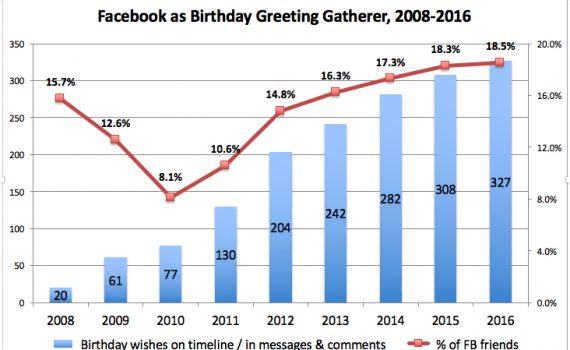
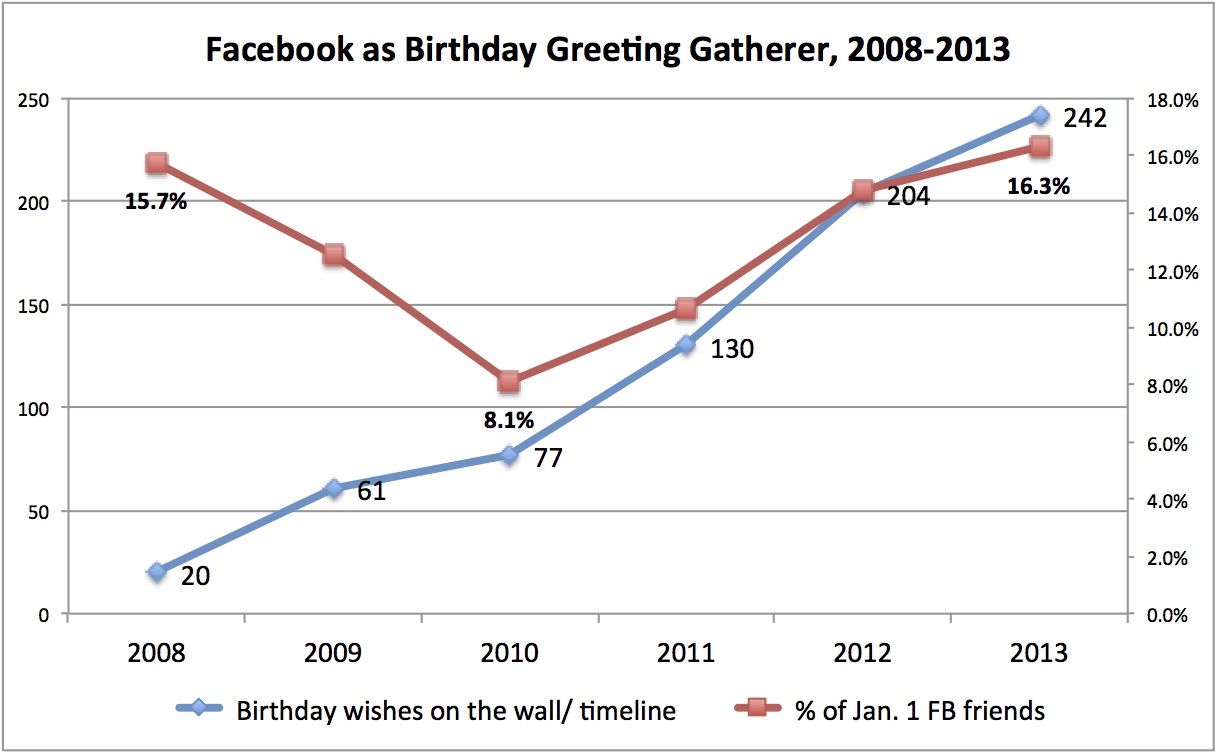
At the same time, my data show a flight to, not from, a particular kind of conversation: The exchange of birthday greetings.

(The reason I have this data at all is that my former Tribune colleague Lara Weber and I share April 24 as a birthday with Mayor Daley, Barbra Streisand, and many other gentle readers. We began comparing notes several years ago across multiple platforms, including email, e-cards, text messages and the like, but the Facebook trend line has enough data to seem the most meaningful. As she said in a post yesterday, “wow. FB is a narcissist’s birthday dream come true.”)

Even though we’re not narcissists ourselves, Lara and I like it too – but truth be told, not everyone does. An easily findable example was posted last August on The Atlantic’s Web site: “The problem with Facebook birthday greetings,” by Adam Clark Estes. (He was actually responding to a defense of the practice the previous weekend by Virginia Heffernan on nytimes.com, which itself was a response to a piece on Slate by David Plotz – I need to stop insert hyperlinks because this is looking to be infinitely recursive).

Plotz threw down the virtual gauntlet by positing, among other things, that “the wishes have all the true sentiment of a Christmas card from your bank.” And here I choose to be utterly clear: I think he’s dead wrong:

First, I got emailed birthday greetings yesterday from my former optician, and another from my car dealer with the warm and fuzzy subject line “CustomerBirthday” (sic). Those are the bank-Christmas-card moral equivalents, methinks.

Second, when I finally sat down and scrolled through all of the greetings last night after returning from a “Faculty Appreciation” event at a Northwestern residential college, what I found was that I was actually . . . sentimental. I found myself picturing each and every one of those greeters and remembering / reveling in / appreciating the genesis and continuation of our relationships. I laughed at a few and teared up at a view and clicked ‘Like’ on a few.

Birthday blitz, iPhone versionAnd it seems like that is, as Heffernan would argue, completely human: “Real humans send the greetings. And they’re customized.” To further quote her, “At this moment, when so many of the world’s markets seem haywire — with the logic of supply, demand, pricing and debt broken — seeing an economy that works as well as Facebook’s birthday feature gives a flash of hope.”

And thus I hope to do better at returning the favor to my 1,449 Facebook friends. Happy birthday today, A.T. and Danae!


Scrabble® at the speed of . . . silicon

Okay, so we’ve known for a while that “Angry Birds” is chewing up most of the free time that technological efficiency has granted us over the last handful of years. If you’ve been wondering, though, about the rest of this “cognitive surplus” (as Clay Shirky calls it), I have that answer for you. As Alec Baldwin reminded us last month, our stolen minutes are probably going to “Words with Friends” from that newly public behemoth of a social-gaming company, Zynga.

Scrabble's iPhone app

As the world knows, Baldwin’s refusal to “turn off his electronic device” got him kicked off an American Airlines flight last month and became a minor cause célèbre. It led to plenty of jokes, a fair amount of tongue-in-cheek self-loathing, and (of course) a “Saturday Night Live” skit in which Baldwin apologizes to himself on behalf of American. Nevertheless, l’affaire Baldwin is not the only thing that has drawn attention recently to online Scrabble® and its many clones. For instance, there was the fact that the iOS version of “the ultimate word game” was a free “pick of the week” at Starbucks recently . . . necessary, most likely, because while Scrabble may be “ultimate,” it ultimately may be at risk of marginalization.

I must begin by confessing that part of the value proposition that drew me to Facebook, back when I joined in August 2007, was one of the earliest of those clones: Scrabulous, a perfect and perfectly executed online rendition. Within days I was engaged in games with friends (and friends’ children) across the country, in fact using it as an excuse to entice some of them onto the network as well.

You see, I’m always looking for Scrabble opponents. Back in the 1970′s, once I was out of college and working nights in the slot of the Tribune sports desk, the opportunities had dwindled to basically three: (1) my friend Ann, with whom I would play with an agreement not to keep score; (2) me, myself, and I, with whom I would play four-handed Scrabble with the board on a turntable (Linda would come home after work, find me at the kitchen table, and ask, “Which of you is winning?”); and (3) the reason I kept paying my annual Mensa dues: Scrabble by mail with other members.

So now it can be told: It’s not electronic bill-paying or e-cards that are causing the Postal Service to crater. It has to be reduced demand for Scrabble by mail! (While I no longer remember the precise mechanics of, say, “drawing letters” with my pencil pals, I certainly recall staring at the mimeographed game-board grid before filling it in and mailing it off.)

Lexulous on Facebook

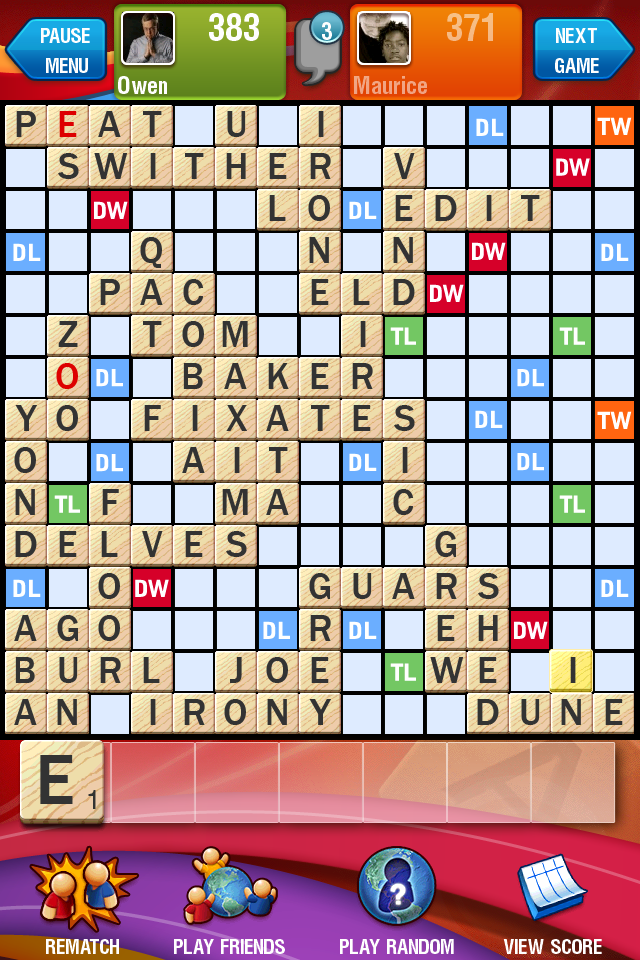
Back to 2007-08. All went swimmingly until Hasbro, the copyright holder, realized it had darn well better assert its intellectual property rights. Over time, Scrabulous’s Indian developers ultimately resurrected it on Facebook under names like “Wordscraper” and “Lexulous,” but with different rules and, most notably, an eight-letter rack of virtual tiles. This last infringement-avoidance attribute led to some amazingly high-scoring games among the 566 I played, many (as in this example) with my old Tribune pal Maurice Possley. But before long I was turning my attention back to “the ultimate word game,” cheerfully paying 99 cents for the iPhone app to go along with the Facebook implementation.

Words with Friends

But then along came this “Words with Friends” thing. No, it’s not Scrabble, nor was meant to be. It has a strange board layout that creates ridiculously high scores for boring single words, even bigger gaps between winners and losers (right), and a seemingly odd distribution of letter tiles. In its favor, however: it also has a virtually unlimited supply of opponents . . . nearly 16 million monthly users, 3,406,673 of whom have “liked” it on Facebook, and at last count 153 of whom are numbered among my Facebook friends.

Frankly, I wish they’d all just switch back to Scrabble®. But if they did, what would THAT do to Zynga’s stock price?

The technological octogenarian

A man, a plan, a canal ... er, an iPhone and Facebook.

A man, a plan, a canal ... er, an iPhone and Facebook.

My father turned 80 on Saturday, and my sister and I and our spouses went out to The Holmstad, my parents’ retirement community in Batavia, for the occasion. Shortly after 5, we were in the Holmstad dining room, the 6 of us armed with our 5 iPhones and high expectations for a festive meal.

Festive meals can, of course, take a while to arrive; so, as photo opportunities go, the one at right was way easier to seize than most. When I grabbed this image with my iPhone camera, I suspected that all I had to do was write the right caption, upload it to Facebook, and wait for my thousand or so Facebook friends to decide if they, too, found it interesting.

“Dad checks Facebook on his iPhone while waiting for 80th birthday dinner to arrive….”

It was just a few minutes after 5 p.m. By the time we got home from Symphony Center (where we went after the birthday bash ended), it had more interaction than any other single thing I’d ever posted on Facebook. “Awesome,” wrote Don. “Dad rocks,” noted Marie. “So that’s the old block off of which you are a chip,” observed Eric.

And then there were all the folks merely clicking Facebook’s thumbs-up “Like” icon. It should be noted that many of them don’t even know him!

It had already been a big day online in Owen World; a very complimentary link from Scot McKnight’s popular beliefnet.com blog, “Jesus Creed,” was sending my Feb. 27 essay on past and future literary artifacts into the top 5 of my posts over the last year. (Scot drove about 4% of my overall traffic in 2009, and at this rate he’s going to achieve his tongue-in-cheek goal of sending me more readers than does Northwestern.)

So is an octogenarian iPhone-ing Facebooker really all that noteworthy? As Linda observed at home tonight, people born in 1930 have had to adapt to changes that are in many ways more dramatic and less incremental then any of us younger whippersnappers. Television, for one. Church-run retirement homes with waitstaffs and Starbucks counters, for two.

So what are you waiting for, gentle readers? Get your dads and moms their own smart phones and social network accounts. And then send them to owenyoungman.com.

Happy birthday, Dad.