Posts Tagged ‘circulation’

Who will pay?, revised and expanded

Wednesday, October 26th, 2011

What's a year of the newspaper worth to you?

This morning, Crain’s Chicago Business quoted me in a story about a possible new books section or supplement under discussion at the Chicago Tribune. Lynne Marek’s reporting indicated that the Tribune hopes to charge separately for it, and she called yesterday to see what I thought.

To expand on the quote she used, I have been saying for a while that the news industry needs to find out what readers want to pay for and do more of it, not just make some changes and hope advertisers will line up in support. Whether a new books section were launched as an add-on to the paper, or as a separate product carrying the Tribune brand, why wouldn’t you seek the answer to that eternal question, “Who will pay?”

In the days when the operative, profitable strategy was to aggregate as much disparate content as possible in order to aggregate as much audience as possible for a range of advertisers, adding a new section “for free” was a viable idea. I did it plenty of times myself. But as advertising dollars flow to disaggregated and targeted niches, news organizations clearly need consumers to pay more . . . and it would be folly merely to charge more for what they’re already doing, or what’s left of it.

Not that charging more is wrong, particularly if you are targeting those who are passionate about the print reading experience. There is a particular conversation I have at every public event, dinner party, charity gala, or board meeting that I attend, and it goes something like this:

Interlocutor: “The Internet is fine, but I need my printed newspaper. I just can’t live without it.”

Professor O: “I understand. I still subscribe to three or four printed newspapers myself.”

Interlocutor: “Do you think they will all go away?”

Professor O: “It probably depends on what you are willing to pay.”

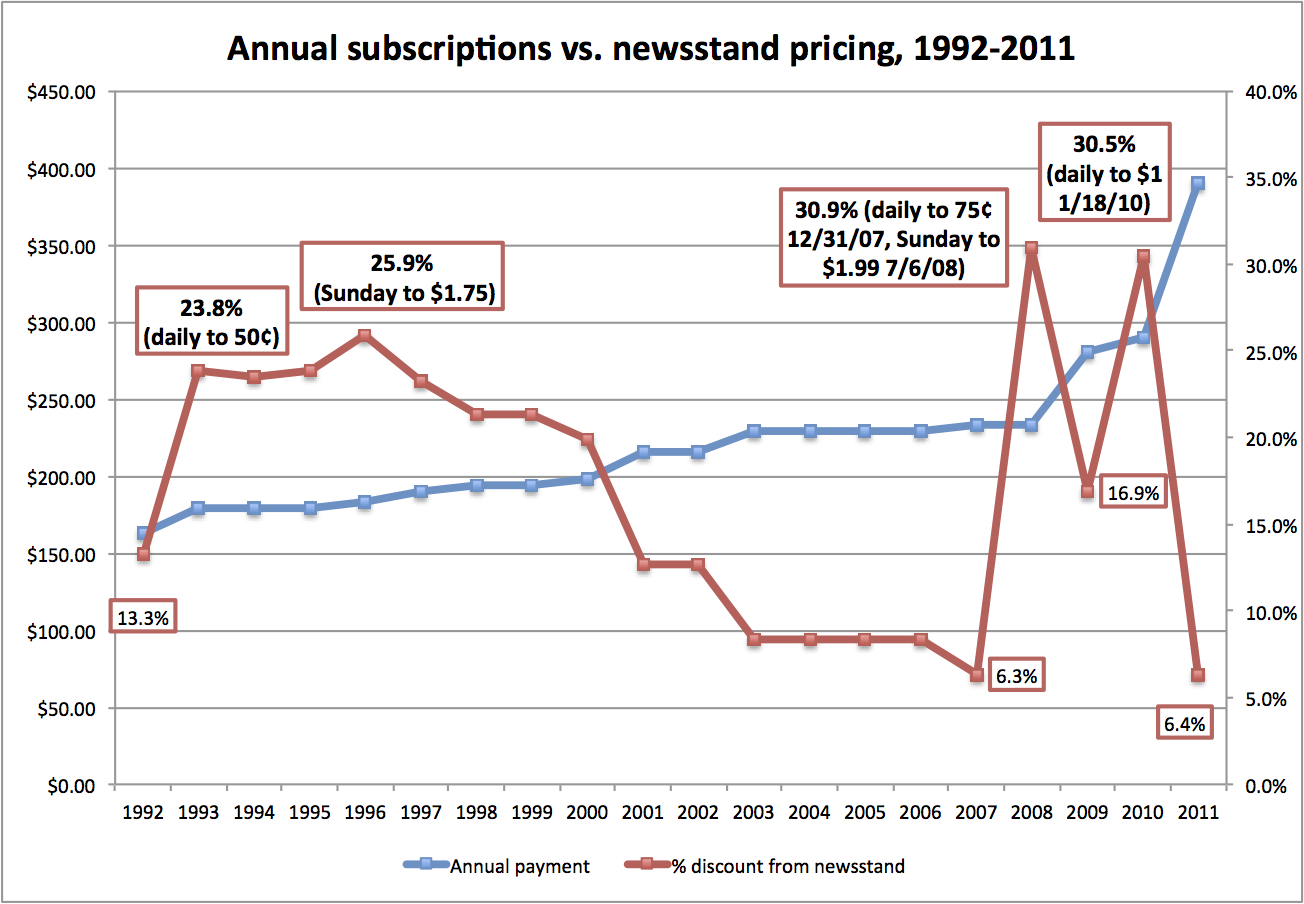
The New York Times has not been shy about finding out what consumers will pay, of course; my annual payment for seven-day service (after credits for vacation stops) went from $550 at the end of 2006 to $700 at the end of 2010 (my quoted rate is $769.60). But as you can see from the graphic at the top of this post, I have way more data — 20 years’ worth, in fact — on my Tribune subscription. And for 17 of those 20 years, home-delivery pricing tracked inflation so closely that the chart isn’t worth showing. (If I may anticipate a potential question, I did not take an employee discount at any time during this period.)

What actually is a little more interesting is the next chart, which compares my annual payments to the “discount” a subscriber received off the newsstand price. This is not a notional number; until moving to the suburbs, I was a newsstand buyer, since my first editor at the Tribune insisted that we buy and read the street-sales edition, not the home-delivered one that had closed hours before the record of the day’s events was complete. The timing of my annual payment, which over time has shifted depending on the Tribune’s internal strategy for changing anniversary dates if there are vacation stops, to some degree accounts for the volatility. But still:

Subscription vs. newsstand pricing

Charge for convenience, or lock in a reliable revenue stream?

When advertising was good (pretty much throughout the 1990′s), there was little reason to worry about the size of the subscriber “discount,” even when the price of the daily and Sunday papers increased significantly. And throughout the early years of the 2000′s, circulators who still remembered the pain of increasing the street-sales price from 35 cents to 50 cents in September, 1982, found equilibrium at or below a 10% differential and stuck with it, trying to retain as many copies as they could, particularly on behalf of preprint advertisers who were paying by the piece. But ultimately the economics had to dictate that, after 15 years, the cover-price status could not be quo, calling the question on how big an increase subscribers might stand for.

The big difference this time around is that with a 20% increase in 2009, and the 35% increase that hit last month, we are seeing an aggressive bet that passion will be more important than pocketbook to a newspaper’s most important audience (seemingly outlandish, preprint-revenue-focused Groupon offers aside). The introduction of the purported pay-as-you-go books section thus would be a variation on that theme.

And one last thing: with this last round of increases, my annual $390 Tribune bill has been uncoupled from the Consumer Price Index. My $162.68 annual subscription payment in 1992 would translate today to $262.36. Formulas like that are likely to be what keeps at least some newspapers, in my interlocutors’ phrase, from “going away.”

Share

Same song, second verse: What cost idealism?

Monday, April 27th, 2009

This morning’s NYT features a dissection of what Brad Stone and Miguel Helft label “the International Paradox”: Social networking and user-generated content sites are finding that huge swaths of their users and traffic are in the developing world – in countries that their current advertisers aren’t all that interested in, and in which they currently aren’t selling much new advertising either”:

Visitors ≠ Revenue.  Hmmm.

Visitors ≠ Revenue. Hmmm.


This intractable contradiction has become a serious drag on the bottom lines of photo-sharing sites, social networks and video distributors like YouTube. It is also threatening the fervent idealism of Internet entrepreneurs, who hoped to unite the world in a single online village but are increasingly finding that the economics of that vision just do not work.

I’m not so sure that either “international” or “paradox” is the right way to define this particular state of affairs.  In fact, I can think of “fervent idealists” in any number of media spaces who have been running up against this problem for decades, with highly unsatisfying results. 

Let’s root around in Wikipedia for a minute:

  • Look magazine’s issue of October 19, 1971, had a circulation of 6.5 million.  Oh, yes, that was the last issue.  Shrinking ad revenue as national dollars shifted to TV, combined with a mail-centric distribution model focused on low-cost subscriptions, got a lot of the blame.
  • Life magazine’s issue of Dec. 8, 1972, had a circulation guarantee of 5.5 million (reduced earlier in the year from 7 million to reduce costs).  Yup, the last weekly issue.  Going monthly was supposed to overcome the problems that had killed Look a year earlier, but not for the long term.
  • In 1990, beginning a trend that would sweep America over the next two decades, the Des Moines Register substantially trimmed statewide distribution of its main edition to reduce costs.  With the revenue model for most American newspapers dependent upon retail and classified advertising dollars, circulating almost any major metro paper to readers too far away to shop locally was just a losing proposition.

In the 1970′s and 1980′s, the early mornings of my own driving vacations around the Midwest often revolved around figuring out where I could go to buy a Tribune; when I was in Hilmar, California, I could drive to the local market and find the San Francisco and San Jose papers in an honor box.  I’m still interested today when I am out of town, but the publishers aren’t interested in moving their dead trees quite that far.  We’ve compromised; I bought a Kindle, way better for my purposes than browsing through nearly anybody’s Web site.

None of this rear-view-mirror stuff is meant to be whining, by the way.  My point is more that, for a long time, media companies have proven that they can assemble large and/or far-flung audiences for their brands of news, entertainment, advertising, and other information.  But, for nearly as long, they have needed (or chosen) to subsidize their assembly of audience by selling them to end users below cost, relying on the advertising revenue stream to cure all ills.

Now, of course, thanks to its circulation pricing model and marketing partnership, I can get a New York Times almost anywhere there is a Starbucks (although that seems to be changing a little, too.  I’ve begun to find out-of-the-way hamlets where the local Starbucks carries only the Sunday paper. Sound familiar?).  The point being that sooner or later, fervent idealism begins to sputter in the face of supply, demand, cost, value, and a laundry list of other market forces.  Back to today’s piece:

There may be 1.6 billion people in the world with Internet access, but fewer than half of them have incomes high enough to interest major advertisers…

Facebook is in a particularly difficult predicament. Seventy percent of its 200 million members live outside the United States…the company faces the expensive prospect of storing 850 million photos and eight million videos uploaded to the site each month.

So how do idealistic entrepreneurs, idealistic journalists, idealistic purveyors of ideas get to serve and perpetuate their ideals?  Can they collaborate with idealistic technologists to create less expensive ways of serving these widely dispersed audiences, or package them in ways that do interest advertisers?  Or can they create models in which the value their users/readers attach to their content actually start to meet the cost of having it provided?

It’s clearly dicey to solve equations that contain more than one unknown.  There are at least five variables in this particular one:  cost, brand, value, convenience, and importance (I put relevance into that last bucket, as well as timeliness and personalization; probably there needs to be an equation just for that).  Getting all five on the left half of the equation so that, to the right of the equals sign, there is a positive number of dollars is not the challenge of the age.  It’s the challenge, period…whether your audience is growing or shrinking, whether your ambitions are grandiose or just grand. It would do society some good to solve this for everyone.  

Volunteers?

Share