The next miracle (v11.1): Owen Youngman

Knight Professor of Digital Media Strategy, Medill / Northwestern

Owen YoungmanOwen YoungmanOwen Youngman

A day with Northwestern in Evanston

So it has been a month since I last surfaced here, during which time my current graduate class, “How 21st Century Media Work,” has been driving steadily toward its conclusion: a discussion this coming Monday of Ken Auletta’s Googled: The End of the World as We Know It. Along the way, a clear highlight was the Monday where we held two moot court sessions, with teams of students assigned to argue different points of view on editorial outsourcing and on so-called* “paid content” strategies.

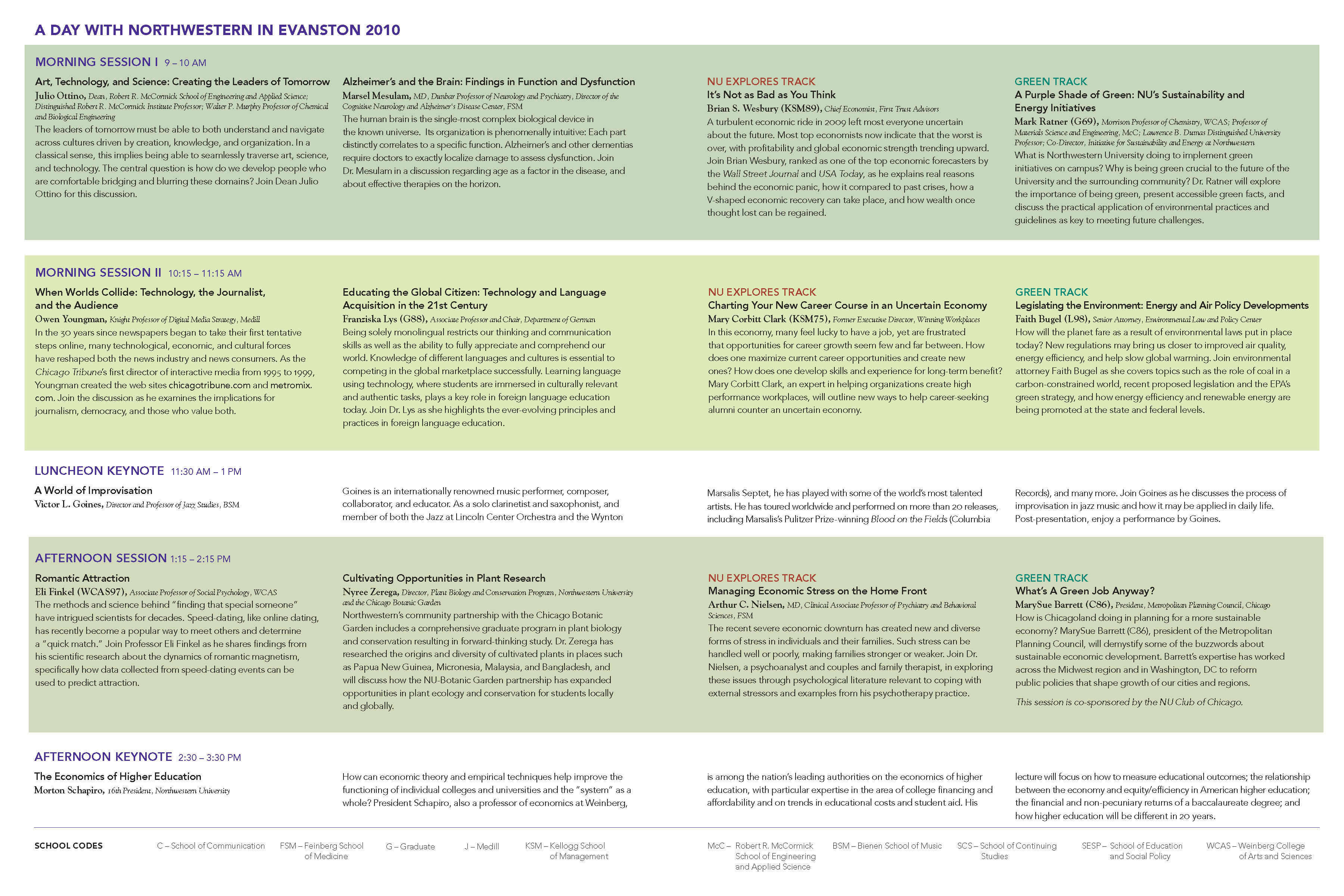
Schedule, A Day with Northwestern in Evanston 2010

Schedule, A Day with Northwestern in Evanston 2010

We pause in this rapidly concluding winter term to mention that I was asked to deliver a lecture at the annual “Day with Northwestern in Evanston” in April. Looks like, even if (especially if) you don’t want to listen to me, it’s a really interesting lineup of presenters, with keynotes by NU President Morton Schapiro and the jazz musician / NU professor Victor Goines.

The brochure says the committee looks for presenters with a “proven track record in the world at large, teaching ability, and relevance to today’s audience.”  Hope I can live up to that.

We now return to our regularly scheduled academic pursuits.


*All uses of “so-called” in The next miracle are dedicated to Jerome Holtzman, longtime dean of the nation’s baseball writers and legendary portable-computer student of mine, who used the so-called hyphenated adjective in 484 different Tribune stories between 1981 and 1999.

Not dead yet, but for how much longer?

As I have mentioned here a couple of times, the students of the fall Interactive Innovation Project at Medill have been studying the past, assessing the present, and projecting the future of obituaries as a form of journalism and as a source of audience and revenue for publishers. Today on its Web site, obitresearch.com, the class released a white paper, “The State of the American Obituary,” that contains their findings.

They report that the central position that newspapers have held in communicating the news of Americans’ deaths is substantially threatened by changes in technology and audience behavior. Unlike other categories of aggregated listings, this is an area where newspapers today still retain a dominant market share.  In fact, Legacy.com Inc. – the Evanston-based aggregator of newspaper death notices that sponsored the research project, and where (disclosure) I am an independent board member – hosts death notices for 7 of every 10 Americans who die each year.

The class found that new user- and family-driven forms of remembering the dead, on social networking sites like Facebook and MySpace as well as standalone memorial sites and services, are attracting audience members who want not only to read about their friends and loved ones, but also to participate in their memorialization. While this began happening as soon as the first Web browsers appeared, the growth of social media, particularly among the Baby Boom generation, is causing an acceleration.

In preparing their report, the eight students who worked on this project conducted quantitative and qualitative surveys, reviewed scholarly and industry research, and conducted interviews with employees at newspapers nationwide. Based on their findings, they conclude with recommendations to media stakeholders on how to adapt to the many changes in the landscape of grieving, remembering and memorializing the dead.

You can download the report here. It was principally written and edited by Ashley Bates, Ian Monroe, and Ming Zhuang.  Contributing researchers were Jake Bressler, Alina Dain, Chris Deaton, Tiffany Glick, and Kate Goshorn.