The next miracle (v11.1): Owen Youngman

Knight Professor of Digital Media Strategy, Medill / Northwestern

Owen YoungmanOwen YoungmanOwen Youngman

Tweeting the tweeter at #Medill

  1. This past week, Medill welcomed NPR’s Andy Carvin as Hearst Visiting Professional through the good offices of my colleague Prof. Loren Ghiglione. Given the sheer volume of his tweets, their reliability, and their pertinence, having @acarvin on campus for a few days was a chance for Medillians to press their noses right up against the window that he opens on the world.
  2. ONANorthwestern
    Good news, Twitter nerds! NPR’s @acarvin is on campus. Go to Fisk 311 at noon for lunch and a talk about tweeting the Arab Spring.
    Wed, May 09 2012 11:47:11
  3. Indeed, “Tweeting the Arab Spring: Capturing History, 140 characters at a time” was the title of the Wednesday talk that would be his last “official” act on this return visit to campus (Carvin is a 1993 communications graduate). And the students were standing by:
  4. DanHillReports
    Hoping @acarvin will livetweet his own talk, but I’d settle for audience updates. This would solve my #MedillProblems. Don’t let me down.
    Wed, May 09 2012 11:49:21
  5. Ah, ’twas not to be. Harsh reality, at least on Carvin’s own part:
  6. acarvin
    @DanHillReports Nope; when I’m talking solo I don’t tweet. Otherwise I’d stop talking and that gets pretty awkward. :-)
    Wed, May 09 2012 12:34:30
  7. But I had already decided that it seemed appropriate to cover his talk in the way that seemed most appropriate: by livetweeting myself. Not that every I captured every worthwhile sound bite, nor that I ever dreamed of maintaining an @acarvin-like pace during his presentation. And so, after a healthy lunch of brownies and chocolate chip cookies, it was time to fire up TweetDeck on my iPad and go.

    What was I looking for among the anecdotes, illustrations and history?  Judging by my tweets, I think I was looking for some wisdom about his particular brand of journalism.
    But you can judge for yourself.
  8. YoungOwen
    @acarvin at #Medill: I’m NPR’s guinea pig-in-residence
    Wed, May 09 2012 13:17:11
  9. YoungOwen
    @acarvin: during #arabspring ‘my Twitter followers were functioning as interns’ #Medill
    Wed, May 09 2012 13:32:30
  10. YoungOwen
    @acarvin: ‘My Twitter account became an amorphous decentralized media literacy experiment’ #arabspring #Medill
    Wed, May 09 2012 13:48:29
  11. YoungOwen
    @acarvin: ‘What I’m doing should never ever be viewed as a replacement’ for the work of journalists on the ground #arabspring #Medill
    Wed, May 09 2012 14:02:34
  12. YoungOwen
    @acarvin: My Twitter account is a news process, not a news product. It’s my newsroom. #Medill
    Wed, May 09 2012 14:09:43
  13. YoungOwen
    @acarvin: If you did a word cloud of my tweets, biggest words would probably be ‘Confirmed?’ and ‘Source?’ #Medill
    Wed, May 09 2012 14:13:55
  14. At 13:30 he was off, freed to tweet again. And again, and again….
  15. acarvin
    I’m at Chicago O’Hare International Airport (ORD) (Chicago, IL) w/ 178 others http://4sq.com/JVzhc4
    Wed, May 09 2012 16:11:44
  16. ….sometimes on war and its casualties, and sometimes on survivors.
  17. acarvin
    “Owing to a lack of mirrors on the ocean floor, the calico lobster was very likely unaware of its own rarity.” http://n.pr/KttbDP
    Fri, May 11 2012 10:59:43

Verbing a noun, in 19 easy lessons

Steven Levy discussing "In the Plex" at Medill, 3/13/2012

The winter quarter at Northwestern is wrapping up, and with it the first offering of my new Medill course for undergraduates from across the university. In response to a suggestion that I find a way to integrate the topics I have been covering for graduate students (economics, marketing, technology, innovation) into the undergraduate curriculum, I went looking for a unifying theme, and I found one in Mountain View, California. Big surprise, eh?

The objective of “The Misspelled Noun That Became a Verb: American Media through the Lens of Google” was to use scholarship, reporting, and reflection about Google to understand the media world around us. The students were to read, think about, react to, and write about excerpts from a handful of books published over the past few years, as well as to combine newspaper and magazine reportage, blog posts, and YouTube videos with observation of their own habits.

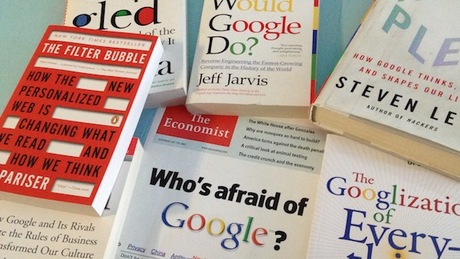
On the books front, the issue was identifying which ones might add up to the broadest view of the topic that might fit into 19 two-hour class sessions, which I devoted to Google’s intersection with individual topics such as research, advertising, news, video, mobile, privacy, and even democracy. Six titles made the cut:

  • The Search: How Google and Its Rivals Rewrote the Business and Transformed Our Culture, by John Battelle (Portfolio, 2005)
  • What Would Google Do?, by Jeff Jarvis (Collins Business, 2009)
  • Googled: The End of the World As We Know It, Ken Auletta (Penguin Press, 2009)
  • The Googlization of Everything (and Why We Should Worry), Siva Vaidhyanathan (University of California Press, 2011)
  • In the Plex: How Google Thinks, Works, and Shapes Our Lives, Steven Levy (Simon & Schuster, 2011)
  • The Filter Bubble: What the Internet Is Hiding from You, Eli Pariser (Penguin Press, 2011)
Jarvis and Vaidhyanathan were gracious enough to Skype in for class sessions during the quarter. William Poundstone, whose Are You Smart Enough to Work at Google? was published in early January, both visited the class and delivered a public lecture (which Vaidhyanathan would have done, too, save for a last-second family emergency). And Levy, as indicated by the photo above, came to campus this week for a conversation with me on stage in the McCormick Tribune Forum (which, if you have an hour and the right version of Microsoft Silverlight, you can watch here or by clicking on the image).

In addition, I was hoping we’d have some news during the quarter to keep things fresh. That part turned out pretty well:

  • On Jan. 12, we were scheduled to discuss the implications for users of personalized search. On Jan. 10, Google launched “Search Plus Your World,” perhaps making it all the more likely that no two people’s search results for the same topic would never be the same again.
  • On Jan. 26, the syllabus called for the first of two sessions on privacy. On Jan. 23, Google announced it was combining 60 of its privacy policies into one; helpfully, it went on to explain why by using some of the same cute stick figures it had been using to outline its extant practices in a print and online advertising campaign it called “Good to Know” (right).
  • On Feb. 2, the topic was video and YouTube. On Jan. 16, the New Yorker ran a fine piece of reportage by John Seabrook about YouTube’s “original channels” initiative. On Jan. 23,  Google launched a cute little Web site to trumpet the factoid that one hour of video is now uploaded to YouTube every second.
  • On Feb. 7, since it was a Tuesday, I had scheduled a focus on Google’s impact on democracy as seen through the presidential primaries and campaign. Here I had expected to use as the centerpiece the previous fall’s YouTube-sponsored Republican debate in Orlando, but on Jan. 31 President Obama cheerfully participated in a Google+ “hangout” that helped to round out our subsequent discussion.

I could keep going, but you get the idea. Did I mention that the Motorola Mobility acquisition passed antitrust muster on the morning of the mobile class?

Add in a visit from by my former Tribune colleague David Tan, now head of SEM agency development for Google, and a field trip to Google’s Chicago offices that Dave hosted near the end of quarter, and you wind up with a pretty interesting quarter, I think. Along the way, the students logged the Google text ads they encountered as they browsed the Web; visited the Northwestern University Library, some for the first time; and debated whether the widespread and automatic use of search engines to answer every question they encounter is making us smarter or dumber.

Tuesday’s public conversation with Steven Levy of Wired was essentially the climax to the quarter, as all the themes and ideas listed above, and many more, pulse through his book. For the purposes of my students (all of them, actually; my graduate students read In the Plex for their final on Monday), it was a chance to hear an expert talk not only about the past, but to publicly mull several possible futures. What might Google do with Lake County-based Motorola Mobility?, an audience member asked. Give away its phones for free to tether its users to Google products and services, he suggested.

What, then, did the students learn, you ask? I could speculate, but I’ll know better in a couple of days, when they turn in their final papers . . . where they have to tell me whether the pronouncements and warnings in the titles and subtitles of our six main books ring true after a quarter of moving the “Googlization of everything” from the background to the foreground of their consciousness.

More sizzle, with plenty at stake

Some four days on, the back-and-forth-and-back-again about how and whether 21st Century journalists should be putting effort into “personal branding” appears to abating. Evidently reporters’ attention has turned to Rod Blagojevich’s corruption conviction, or maybe David Carr’s NYT piece on the TMZ newsroom, “A Newsroom that Doesn’t Need News.”

Admittedly, there may be a brief resurgence, because Gene Weingarten – whose Washington Post column addressed to one of my Medill grad students started the “foofaraw,” as he and I independently began to label it – addressed it today in the preamble to his monthly live chat on washingtonpost.com. Among other things, in it he answers Steve Buttry’s implied charge that he is “something of a mischievous hypocrite” (see Buttry’s Storify curation, “Gene Weingarten has a powerful personal brand“).

(I note with interest that an early synonym for “mischievous hypocrite” – “designing villain” – would itself seem to be a brand-in-waiting, though in this case it has been waiting since 1822 according to Google Books. I digress.)

After reading the chat transcript, I guess that at the end of the foofaraw, @geneweingarten and @youngowen (in my previous blog post) are going to wind up disagreeing about whether we might be even in fractional agreement, short of our appealing to Lamont Cranston for a ruling.

I further guess that I am kind of sad that his response correlates the issue with a timeline that stretches from an era when “if you were a journalist, you swaggered. You felt invincible” to one when “We no longer were the smartest people in the room, telling people what we knew they needed to know . . . We were supplicants, salesmen, trying to interest a customer in our wares.” Not that this is even the most powerful or persuasive part of his response, which despite his best efforts often avoids being smug and dismissive. It’s just the one that makes me sad, because it swerves around the point.

I want the same things for my students that I think Gene wants for the young journalists he mentors. Where we disagree is that I think that if their good work helps them make “branding” a weapon in their personal arsenals, they won’t wind up being salesclerks; he implies that by so doing, taking the concept “straight from the evil, cynical world of marketing,” they already have become salesclerks. I guess we’ll need to compare notes at the checkout counter.

Let’s not fail to mention two other good links on the topic, among many that are floating around. Mindy McAdams, who holds the Knight chair in journalism at the University of Florida, used her blog to ask and answer, “Branding: Should journalists build a personal brand?” And Steve Buttry has followed up his “well-executed curation of the entire foofaraw” (Weingarten) with “Confessions (strategies) of a branded journalist,” structured as a set of imperatives that might be viewed as a menu, a map, or even a mandate.

So thanks, Gene and Steve (and Mindy and Leslie). I’m thinking the odds are good that, the next time I teach “How 21st Century Media Work,” this closing assignment will be better framed, more tightly constructed, and even more focused on launching my students back into the lands beyond Medill. Because that’s what at stake: important journalism from skilled journalists that actually reaches its intended audience, in a fragmented media world where swagger cannot provide a shortcut to impact.