Archive for the ‘Essays’ Category

“All passes. Art alone endures.”

Wednesday, January 27th, 2010

51q7RzjhPKL._SL500_AA240_Monday night on the way home from Northwestern, I stopped at the local Borders in order (finally) to act on a pre-Christmas recommendation from Tribune literary editor Liz Taylor: to purchase A New Literary History of America, edited by Greil Marcus and Werner Sollors. Before long I was reading about The Wonderful Wizard of Oz, The Great Gatsby, The Southern Harmony . . . and there were still a thousand pages to pick from. (This timeline is a great thing to scan for a sense of this remarkable compendium of new writing. Fifty bucks list, but with a gift card and a coupon it seemed like a good thing to actually pick up in a bricks-and-mortar store.)

I didn’t want to overdose, though, so after a while I set it down and belatedly picked up Sunday’s edition of the New York Times Book Review. In so doing, I thought I would be transitioning from the past to the present, in addition to reducing the weight of the analog object in hand.

But no.

More than meets the eye, or the cursor for that matter.

More than meets the eye, or the cursor for that matter.

As it happened, the Book Review was upside down in my stack of unfinished reading, and on the back page was the monthly ad from Bauman Rare Books in New York City. I usually do spend a couple of seconds glancing at the store’s featured offerings, but this week it stopped me cold. And I quote:

  • John Milton: Paradise Lost, 1668. “One of the greatest, most noble and sublime poems which either this age or nation has produced.” First edition of Milton’s masterpiece, in contemporary calf.
  • Mark Twain: The Adventures of Huckleberry Finn, 1885. “All modern literature comes from one book by Mark Twain. It’s the best book we’ve had” (Ernest Hemingway). An extraordinary American rarity: Mark Twain’s own copy of Huck Finn, signed by him, in publisher’s sheep. Full first issue, one of the earliest known copies.
  • F. Scott Fitzgerald: The Great Gatsby, 1925. One of the great rarities in American literature: first edition in the first-issue dust jacket of one of the most desirable works in modern literature.

It’s not like I had set out to muffle the drumbeats in advance of what turned out to be the Apple iPad. And maybe it was because I had just been reading about Scott and Zelda and Gatsby and Nick Carraway in the New Literary History. For whatever proximate cause, I was thinking not just about the titles or the authors or the cultural resonance of either, but also about the form factor that is part of what transformed these objects into not just collectibles, but representations of the power of words, and of ideas.

At some point, should the Great American Novel ever be written, some substantial number of its readers will absorb it in a form utterly unconnected to such an artifact. Afflicted as they are by permanent partial attention disorder, they will labor doggedly to identify and retain “the good parts” across the multiple brief sessions of hard-won reading time they are able to devote to it. And when their children’s children come across it 30 years after acing their own 21st Century Literature classes, what will be the touchstone that summons up what two sentences on a first edition of Gatsby does today?

Over the stage at Norton Memorial Hall, the opera house on the campus of the Chautauqua Institution, are the words “All passes – Art alone endures.” As a lad, I would annually contemplate this translation from the poet Théophile Gautier (Tout passe. L’art robuste / Seul a l’éternité . . .) as I sat in services or meetings during a week-long family retreat held by the Covenant churches of what was then called the Middle East Conference. The speakers and conferees, of course, had a substantial disagreement with the details of that sentiment, but there it was, overhead, while they spoke and sang to different points below.

No, I didn’t know then it was Gautier, any more than I knew before noon Wednesday that the Apple tablet would be called the iPad, any more than I am able to answer my own question immediately above. I’m already reading on a Kindle and an iPhone; undoubtedly I will before long be reading on an iPad and a Que. But, a digital fellow though I may be, I find myself clinging to an emotional attachment to Bauman’s trove of objects that I never will have or hold.

No, they’re not the art, those objects; Hemingway and Fitzgerald do not endure because of their first-edition dust jackets. But I want to hope that the flash and dazzle of the Next Big Thing does not get in the way of the establishment of the Next Important Thing. And these days, I’m not feeling all too sure.

Dead trees and dying cities

Thursday, October 22nd, 2009

The New York Times’ decision to add pages of metropolitan-area news to copies of the papers circulated in San Francisco (last week) and Chicago (Nov. 20) is, if nothing else, an interesting juxtaposition with its nearly contemporaneous announcement of 100 layoffs in the newsroom. By contracting with newly formed local news entities, it doubtless will acquire high-quality content at less cost, and with less long-term liability, than had it staffed up to do the same thing (or had transferred folks to the hinterlands).

Official word came today that in Chicago, several of my former Tribune colleagues are launching the Chicago News Cooperative – not only to supply stories to the Times, but also to repopulate some of the beats and coverage areas that have been affected as the Chicago papers have laid off staffers, reduced newshole, and changed their focus and approach. (When current Tribune editor Gerry Kern delivered the Crain Lecture here at Medill recently, the editorial changes at the Tower were among the topics he addressed; the text of the lecture is here, and here is an interactive video that includes both his remarks and the slides he used to illustrate them. The video requires Microsoft Silverlight. The fact that I delivered the introduction to the lecture may be reason enough not to download Silverlight and view it.)

Of course, the number of Starbucks available to sell the Friday and Sunday NYT in Baghdad-by-the-Bay and Beirut-on-the-Lake might also be a reason for the Times to start its metro news initiative in those two cities.  But I think an answer even deeper than journalistic idealism or straight competitive instincts is lurking in the cover story of the November issue of Harper’s, by Richard Rodriguez: “Final Edition: Twilight of the American Newspaper.” (It’s not available online except to subscribers.)

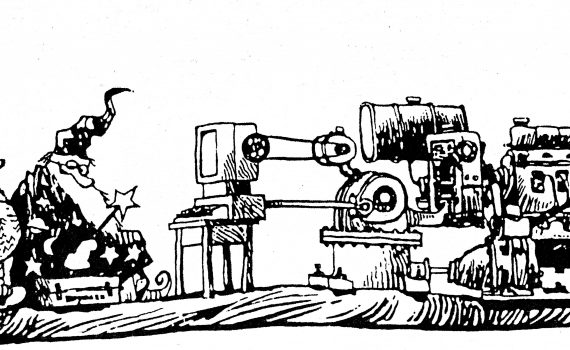
Wrinkle in Time (detail), by Steve Mills: Cover art from the November issue of Harper's.

Wrinkle in Time (detail), by Steve Mills: Cover art from the November issue of Harper's.

Rodriguez got my attention back in June when he gave an interview to New American Media on “The Death of the SF Chronicle” that included the following: “I don’t think the Chronicle is dying so much as I think that San Francisco is dying. When a metropolitan newspaper of that magnitude  stops publication it indicates that there has been a death of the metropolitan ideal.”

This piece in Harper’s expands on his theme of “the death of place,” but also is far more expansive on the Chronicle in particular, newspapers in general, and most especially of San Francisco.

(more…)

Who will pay?

Friday, September 11th, 2009

It was a piquant question . . . well, piquant if you took it the right way . . . and then-Chicago Tribune publisher Scott Smith seemed to ask it at all the right times.

“Who will pay?”

There was never any shortage of product ideas, and in fact never a shortage of good product ideas, at the Tribune during Scott’s era, roughly 1997 to 2008. For nearly all of these ideas, it was a simple matter to quantify and project the costs. For nearly as many, it was pretty straightforward to estimate the size of the audience and its members’ potential enthusiasm.

“But who will pay?”

Were there advertisers out there – real ones, not notional ones – ready to support this idea with actual dollars (and would those dollars be new, or just shifted from somewhere else?)? Were there potential partners willing to help bear the costs due to mutual self-interest? Or might there be actual consumers ready to fork out a quarter, or a couple of bucks?

Once in a while, we could answer Scott’s “pleasantly stimulating” question, and before long we’d have a RedEye or a Chicago Home & Garden or a Triblocal.com. But probably more often, we had to confess that we just had no idea.

I flashed back to this question today when I read of the demise, or transition, of the Chi-Town Daily News, ex-Tribune reporter Geoff Dougherty’s effort at nonprofit community journalism. (For a dandy compendium of links to reports and analysis, from harsh to hushed, head over to Eric Zorn’s Change of Subject at chicagotribune.com.)

(more…)

The death of ‘place,’ the death of papers

Saturday, June 6th, 2009
Richard Rodriguez: "The civic fabric has been ruptured." Richard Rodriguez: “The civic fabric has been ruptured.”

I don’t think the Chronicle is dying so much as I think that San Francisco is dying. When a metropolitan newspaper of that magnitude  stops publication it indicates that there has been a death of the metropolitan ideal.

via Richard Rodriguez: The Death of the SF Chronicle – NAM.

In 1995, Witold Rybczynski published his classic assessment of the devolopment of the American city, City Life. One reason I remember it so clearly is his long lool at Chicago, where “in many ways twentieth-century urbanism got its start.”  More famously, of course, he argued that it was perfectly OK that American cities were not at all like Paris. He refers only glancing to the role of newspapers, though many writers have documented the ways in which the fates and fortunes of cities and their newspapers have always been intertwined.

I was reminded of all this today when I encountered an interview with Richard Rodriguez, the American writer whose prominence stems partly from  his memoir Hunger of Memory and partly from his ideas about ethnicity and identity, at the website of New America Media.

The edited transcript (and the whole interview, provided as an MP3 on the site) constitute a powerful alternative take on 2009′s inescapable “death of journalism” discussions, articles, posts, and memorial services.  Not because the idea is entirely sui generis, obviously; if newspapers and cities grew together, it might well follow that they might die together. But because of Rodriguez’s argument that “Americans are going to news outlets, not for what news used to provide — the sense of the local, the sense of the parochial, the sense of this place–but rather almost as an escape from place.”  In fact, he says that even the metaphors we use about the Internet – “the ether,” “cyberspace,” “the superhighway” – are “almost against the spatial.”

imagesThe jumping-off point is a question about the San Francisco Chronicle, as are several of the examples and explanations Rodriguez cites.  But Rodriguez’s thesis is as much about the idea of a city as it is about the fate of The City, and it summoned up for me a definition of a city that I think I learned in philosophy class: a community founded on common acceptance of social norms.

When I Googled this last idea today, I was reminded that this is close to the Stoic idea of a city, as a community of virtuous people, “something morally good” (Clement of Alexandria).  Does it follow that if a city dies, the moral good that newspapers can do must die with it?  I’m not ready to go there yet.  But let me give the last words to Rodriguez, and then you can go read or listen yourself at one of the links above:

“The civic fabric has been ruptured. It may be 30 years in the making, but it’s happened now, and we blame the Internet or we blame computers; we blame children because they have an addiction to buttons instead of to paper. But these are really afterthoughts.  These are not the reasons the newspapers are dying…By the 1980′s, there already is the sense that San Francisco is losing interest in itself….People tend not to know what they need until they lose it.”

Hmmm. Should Peter Pan have signed up for unlimited texting?

Wednesday, May 27th, 2009

It was 1995 or so when I first came across Sherry Turkle. Her book, “Life on the Screen: Identity in the Age of the Internet,” was intriguing academics, scaring parents, and launching incomprehensible book reviews from coast to coast.

Now, a quick word of caution: You can’t apply today’s context to the title. The MIT professor’s book was focused not on the just-emerging World Wide Web, but on the role-playing games that had been proliferating online and the people who inhabited the MUDs – multiple-user domains – that helped define them. Guess what: some of them viewed “RL” (real life) as just another role-playing game … another “screen” to be navigated through … and as such a world no more or less valid than that inhabited by any of their avatars.

But no, that’s not the scary part. (more…)

Maybe, just maybe, you should merge with me. (Not.)

Thursday, April 30th, 2009

Well a crazy woman and a neurotic man
Should never, ever, ever make a wedding plan…

– “Maybe Just Maybe,” Bruce Roper

===

The Saturday after the AOL-Time Warner merger was announced in January, 2000, I appeared at an Internet conference at the Kellogg Graduate School of Management.  I got a really swell gym bag out of the deal, but first an audience member asked what I thought of the deal, as part of a Q-and-A.  

I frankly don’t remember what the panel was about, but I do remember my answer to the question: I quoted the first two lines from the Sons of the Never Wrong’s “Maybe Just Maybe,” reproduced above.

After the tittering subsided, I said that, after nearly a decade of working with AOL at the Tribune and half a decade of running the Chicago Tribune’s web sites, I didn’t see a business model that made the price remotely make sense.  I was back on the “print side” just then, having emerged alive but 50 pounds heavier after 4 years as Chicago Tribune director of interactive media, but it wasn’t where I was sitting that made me say that.  It was the uncertainty that hung over every minute – and every decision, whether minute or not – related to the Internet those days.

“Because the deal does not carry a set price for Time Warner shares, investors who choose to hold the stock for the long haul must not only believe in the Internet as a place to shop and gather information, but also as a profitable business,” the New York Times wrote on the morning after the deal was announced.  

The math said that the merged company would have a capitalization of $350 billion. Today, TWX closed at $21.83, which works out to $26 billion.  And today I am thinking about this because of another Times piece, Time Warner Expects to Spin Off AOL:  ”Time Warner is inching closer to an untangling of what many consider one of the worst mergers in American corporate history by shedding America Online,” it begins.

N0w, I’m no genius. I didn’t make any money on the Internet bust, though I kind of expected there would be one.  I was hoping that media companies would leverage their transitory moment of strength while the Web world regrouped.  I was thinking that Time Warner was putting itself in position not to participate in this incipient Indian summer, and I was OK with that.  And I was remembering some of the AOL people with whom I had, shall we say, philosophical disagreements.

The substance of those disagreements?  They tended to talk about deals, stock prices, liquidity events, and leverage.  I tended to talk about users, journalism, community service, and utility.  ”You know the trouble with you newspaper guys?”  one of them snarled at a few of us in a meeting one day.  ”The way you think, you’ll never be millionaires.”

Fast forward to today, and  the last quote in today’s Times, from Time Warner CEO Jeff Bewkes: ”We know that most M&A in the media sectory has not created value.”

Indeed.  We are too soon old and too late smart.  Can we get back to talking about the audience now?  It won’t get us out of the current bust overnight, but it ought to create a sustainable future.

RT @BardofAvon: There’s villainous news abroad

Thursday, April 23rd, 2009


Lord, what fools these mortals be.

Lord, what fools these mortals be.

Not only is it Shakespeare’s (observed) birthday, Mayor Daley famously has proclaimed it “Talk Like Shakespeare” Day in Chicago, leading to all kinds of odd behaviours…including a reporter showing up on last night’s WGN News in quasi-Elizabethan costume. 

Gets one to thinking, though.  So many people are commenting these days on the news business, journalism, digital media, and related topics these days, we ought to give ol’ Will a chance.  Will he be as downbeat as Jeff Jarvis?  As perceptive as Steve Yelvington?  Herewith The Next Miracle’s interview with the Bard.

TNM:  Nice to see you, sir.  That new picture that surfaced a few weeks ago doesn’t do you justice.

WS: Mislike me not for my complexion. [Pause] How much more elder are thou than thy looks!

TNM: Gee, thanks.  With flattery out of the way, down to the subject at hand.  You’ve probably heard that the “traditional” news business is considered by some to be on the verge of extinction….

WS:  This news which is called true is so like an old tale that the verity of it is in strong suspicion. 

TNM: I can relate to that.  But I was going to add that, ’twere true, it might be bad news for you, since so many theatres that perform your works today still rely upon these media for their ability to reach a literate audience.

WS:  The very life-blood of our enterprise. [Shakes head] True it is that we have seen better days.

TNM: One theory is that the media are not delivering the kind of information that people want any more.

WS: Though it be honest, it is never good to bring bad news.

TNM: You’ve got a point; there has been a lot of bad news lately.  Still, there are those who say that “The Media” has been in for a comeuppance.  On the other hand, when I read the blogs and the trades, I find that there is an awful lot of piling on, almost obscuring the justifiable criticism.

WS: Through tatter’d clothes small vices do appear;
Robes and furr’d gowns hide all.  Plate sin with gold, 
And the strong lance of justice hurtless breaks; 
Arm it in rags, a pigmy’s straw does pierce it.

TNM: Not much gold these days to ward off either sin or virtue, I guess, and regardless of the motives of the critics.

WS: A very ancient and fish-like smell.

TNM:  How acquainted are you with the new technologies, by the way?  Did you hear about the company in Orlando that staged “The Taming of the Shrew” on Twitter?

WS: Men of few words are the best men.

TNM:  I should have known. But you probably still see utility in words on a page, I’m thinking.

WS: I love a ballad in print, a-life, for then we are sure they are true.

TNM: At the same time, would you agree with me that there is value in the new model for media in which the audience has a stake in, and helps to create, the content that shapes community discourse and decision-making?

WS: It is the disease of not listening, the malady of not marking, that I am troubled withal. [Pause] Let none presume to wear an undeserved dignity.

TNM:  Hear, hear.  Before we close, surely you must have some advice for the people who are working so hard to bring their companies and their communities through this recession we’re in by disseminating accurate news and information, whether in print or online, whether in startups or established companies.  What would you tell them?

WS: Love thyself last: cherish those hearts that hate thee;
Corruption wins not more than honesty.
Still in thy right hand carry gentle peace,
To silence envious tongues: be just, and fear not.

TNM:  Thank you, William Shakespeare.

I have heard people rant and rave and bellow…*

Thursday, April 16th, 2009


Note to self:  Good news sells, too.

Note to self: Good news sells, too.

Wednesday night when I got around to updating my Facebook status, I was in a whole different state of mind than I was Monday morning after reading the NYT business section.

Apparently I was in a whole different state of mind than a few other folks, as well, based on the public and private reactions to my announcing that I had “Spent a day with smart high school students after spending a couple weeks with smart college students. I feel good about the future, including the future of journalism.” 

(Of course, this was before I read the Sun-Times Media Group’s 2008 annual report, full of cheerful phrases like “the economic obsolescence occurring in the newspaper and printing industry,” but I digress.) (more…)