The next miracle (v11.1): Owen Youngman

Knight Professor of Digital Media Strategy, Medill / Northwestern

Owen YoungmanOwen YoungmanOwen Youngman

In the land of the jólabókaflóðið

Cover art from McSweeney's 15, by Leif Parsons

Iceland, by Leif Parsons. From the cover of McSweeney's Quarterly, Issue 15.

I had the good folks at Visa on the phone, taking the precaution of telling them we’d soon be out of the country. We’d hardly want any potential overseas retail impulses to be impeded by the usual algorithms.

“And where will you be going?” asked the customer service rep, having first obtained the dates of our trip.

“Iceland.”

Pause. “Iceland? But no one goes to Iceland!” And she proceeded to make me spell the names of as many Icelandic towns as I could remember . . . Akureyri, Reykjavík, Isafjörður. (Although I did, over the phone, ignore the diacriticals, eths, and thorns.)

A little research shows, actually, that half a million people “go to Iceland” as tourists each year, in the aggregate outnumbering the 319,000 residents if not the 6 million Atlantic puffins. Many of them go for the volcanos, the waterfalls, the glaciers, and the birds, visiting the natural wonders that ring the island. Others go for the history, visiting the site of Europe’s first real parliament, constituted in the year 930 at Þingvellir.

We went for those things, too, but our journey began in the pages of a novel. Although Iceland is a surprising place in any number of ways, don’t be surprised by this.

(It is, however, OK to be surprised by facts like these:

  • Reykjavík is closer to New York City than is San Francisco, thanks to Great Circle routes.
  • Iceland is warmer in winter than much of the U.S., thanks to the North Atlantic Current.
  • The nation consistently ranks as one of the ten “happiest countries in the world,” thanks to the fact that it’s dark all winter.  [Just kidding about the reason; read the Iceland chapter in "The Geography of Bliss" by NPR's Eric Weiner for more.] )

The reasons not to be surprised by the literary genesis of the trip are nearly as numerous as Icelandic books and authors, of which there are more, per capita, than in any other country. According to a 2004 essay in Issue 15 of “McSweeney’s Quarterly” by Birna Anna Björnsdóttir, a thousand books are published each year for what was then a population of 290,000. “Since the medieval times,” she writes, “Icelanders have written more books than can reasonably be expected from a small peasant population at the edge of the arable world.” About a thousand new books are published every November and December, one for every 300 people or so, in what is known as the “Christmas book flood” (cf. this post’s subject line).

Birna Anna goes on to quote Halldór Laxness’s speech upon receiving the 1955 Nobel Prize for Literature, in which he paid tribute to Iceland writers who “century upon dark century . . . sat in their mud huts writing books . . . There was no fire in their miserable dwellings at which to warm their stiff fingers as they sat up late at night over their stories. Yet they succeeded in creating not only a literary language  . . . but a separate literary genre.”

Owen Youngman at Gljúfrasteinn

Outside Halldór Laxness's home, Gljúfrasteinn, near Mossfellsbær, July 2011.

Preach it, Halldór. As readers of this Web site (or of my Facebook info page) might guess, his novel Independent People started me down the path to Reykjavík when I read it in 1997, directed to the book by a brief piece by Jane Smiley in the Tribune Books section. “This is the sort of book,” she wrote, “that reminds you how glad you are that you learned to read in the first place.” Being already a reader of Smiley’s, I took her advice, learning in the process not just about the perils of overemphasizing self-reliance, but of sheep, coffee, and redemption. Before long I was hunting down the rest of Halldór’s translated oeuvre – another favorite is The Fish Can Sing – and learning that Icelanders without fail refer to one another by their first names.

Without fail, Icelanders also point to their sagas as the jumping-off point not just for their literary heritage, but their sense of themselves and their country. So before long I was reading the Sagas of Icelanders, composed and then written down over the first few centuries of the last millennium. As many an Iceland tourist guidebook points out (we used the spanking new 2011 edition of Frommer’s), many of the locations are findable – though not as well labeled as, say, Gettysburg, and on roads not necessarily fit for a rental car with normal clearances between undercarriage and “gravel.” And many of the sagas also seem to have their own museums.

Reputed durial mound of Skalla-Grímr Kveldulfsson, Borgarnes, Iceland

Who is buried in Skalla-Grímr's burial mound?

So in Borgarnes, after viewing an imaginative retelling of Egils Saga at a family-run museum called The Settlement Centre, we drove to a park containing the reputed burial mound of the father and son of that tale’s antihero, Egill Skalagrímsson. Arriving just 10 years after Iceland was first settled by the Norwegians, the members of this family dispatched friends, servants, relatives, and foes with cheerful abandon, often when they were classically “berserk” (an Old Norse word that moved almost unchanged into English).

The Saga Centre, Hvolsvöllur

Careful with that axe, Gunnar!: The Saga Centre

In Hvolsvöllur, we visited The Saga Centre, which is dedicated to Njáls Saga, another classic so central to the Icelandic identity that Halldór Laxness himself published a critical edition. This one is sometimes called “Burnt Njál’s Saga” because the eponymous subject was burned to death in his home by enemies of his sons as part of the never-ending series of score-settlings and revenge killings that litter the sagas. Njál himself was more of a legal scholar than a Viking marauder, and so his saga has a second lead character: the handsome and violent Gunnar Hámundarson, ultimately done in because he didn’t listen to Njál and because he did slap his beautiful but ill-tempered wife.

Kleifarvatn, Indriðason's "Draining Lake"

The Draining Lake, currently not draining

But as McSweeney’s pointed out, Icelandic writing is not limited to the prose and poetic stylings of dead Vikings or deceased Nobelists, and books by some of the current crop of authors are making their way into English and beyond. The current craze for Scandinavian murder mysteries has benefited writers like Arnaldur Indriðason, whose depressive detective Erlendur has appeared in 11 novels so far. One of them, The Draining Lake, takes its title from Kleifarvatn, a lake near the international airport that started to drain away through fissures after a 2000 volcanic eruption. We stopped there, too, giving us a thousand years of up-close-and-personalness in just the space of a few days.

Of course there were puffins and sheep and waterfalls and volcanoes in our 12-day trip, as well, with the requisite deep dives into geology and history; if you’re interested in any of those, here’s a 22-minute slideshow (works particularly well on the iPad). But it is the authors, named and unnamed, who got us started. As Halldór Laxness put it in that Nobel acceptance speech, “They live in their immortal creations and are as much a part of Iceland as her landscape.”

And so they are.

The meaty sizzle of a 21st Century brand

Last Saturday, June 18, was the day that 2011 Medill graduates received their BSJ and MSJ degrees at a convocation on campus. This followed by a day Northwestern’s commencement ceremonies, which featured the advice of speaker Stephen Colbert (full text | 5-minute video): “You have been told to follow your dreams. But what if it’s a stupid dream?”

Evan Smith

Evan Smith addresses Medill's 2011 graduates

The speaker at Saturday’s event was the equally entertaining Evan Smith, editor and CEO of The Texas Tribune and a Medill alumnus himself. As is the wont of graduation speakers everywhere, he, too, provided advice to the assembly (video on this page), and about 9:30 into his speech he launched into it.

“First, build and burnish your personal brand, using Facebook and Twitter and Tumblr and whatever other channels you can think of.  It used to be that having a personal brand was frowned upon. . . . Today, fragmented, frayed institutions realize – well, the smart ones realize – that powerful personal brands can reverberate upstream in very positive ways. . . .

“But forget about how your personal brand benefits your employer. Think about how it benefits you. It’s portable – goes everywhere you go, from place to place and job to job. You control it. You can be nimble and strategic and tactical attending to it, asking no one’s permission and no one’s blessing. And all the good things about you – your sense of humor, your charisma, your wisdom and your insight – are on display at all times for the world to see. It truly opens up all kinds of possibilities.”

At least one of the students on hand wasn’t too surprised.  She had interviewed Smith just weeks before for her final assignment in my course, “How 21st Century Media Work,” a class on economics, marketing, and technology and their evolving impact on journalism and the media. Students write a paper on how a journalist from their hometowns had, wittingly or not, built a personal brand; what its impact on the audience might be; and whether it would be desirable, or even possible, to replicate anything about that process.

The paper on Smith was a fine piece of reporting, writing, and research, as were many others written by my 39 students . . . like the one on Gene Weingarten, two-time Pulitzer winner from the Washington Post. But there was a difference: Weingarten didn’t much like the assignment.

In response to an initial inquiry, he explained, “You used the expression ‘built your personal brand.’ I want us to let that expression marinate in its own foulness for a moment, like a turd in a puddle of pee, as we contemplate its meaning and the devastating weight of its implications….” At his recommendation, the student included the text of his initial reply in her paper, for which he did grant a helpful interview.

As some of you know by now, this story doesn’t end there. Yesterday, Weingarten’s latest column hit washingtonpost.com: “How ‘branding’ is ruining journalism.” Addressed to my student, Leslie, the column goes to great lengths to explain the wrong-headedness of the idea, after first providing some utilitarian advice: “The best way to build a brand is to take a three-foot length of malleable iron and get one end red-hot. Then, apply it vigorously to the buttocks of the instructor who gave you this question. You want a nice, meaty sizzle.”

As I do tend to include a visual of a branding iron when introducing the concept to students, this was not particularly upsetting to me or to Leslie.

The column drew plenty of comment online, some of it from Steve Buttry of Journal Register, who blogged about it on “The Buttry Diary” with the headline, “Gene Weingarten knows branding (even though he scorns it).” Steve’s post led me to out myself as the professor in need of a sizzling personal branding experience, which in turn led him to ask Leslie Trew Magraw for permission to reprint her research paper; you can find it here.

As I mentioned in my own comment over on Steve’s blog, my students are prepared for the fact that their selected subject may never have engaged in intentional brand-building. They also know that more than a few will reject the very idea of their brand outright, as Gene did so entertainingly. I suspect that both interviewer and interviewee often find, as some of the commenters on The Buttry Diary are saying today, that this is in large part a disagreement over word choice and semantics.

Because, you know what? Paper after paper shows that effective personal branding turns out to be less about self-promotion and social networks than it is about accuracy, fairness and credibility. Whether the subject is a blogger in Portland, or a newspaper reporter in Kankakee, or a TV anchor in Florida, it turns out that the work creates the brand, and the brand then helps people find more of the work. Look at “brand” as shorthand or a shortcut, but don’t look away because you don’t like the word. That would be short-sighted.

That’s not the only way that 21st Century media work. But it’s a way that new journalists need to know, and to learn about through their own reporting. As Evan Smith said, “It truly opens up possibilities.” Or as Stephen Colbert put it, “Thankfully, dreams can change. If we’d all stuck with our first dream, the world would be overrun with cowboys and princesses.”

June 25 update: Steve Buttry has used Storify to curate the many tweets, blog posts, and comments about this back-and-forth today on his blog. It’s well worth a read. Meanwhile, the firehose of Romenesko has been driving lots of traffic to both of our blogs over the last couple of days, and Leslie Magraw’s research paper is drawing a lot of links and comments.

Local Fourth sees a hyperlocal future: Part I

Back in the fall of 1996, I was immersed in publishing hyperlocal news on the Internet. I just didn’t know it.

Digital City Evanston logo

That was then (1996). Click to see the whole home page.

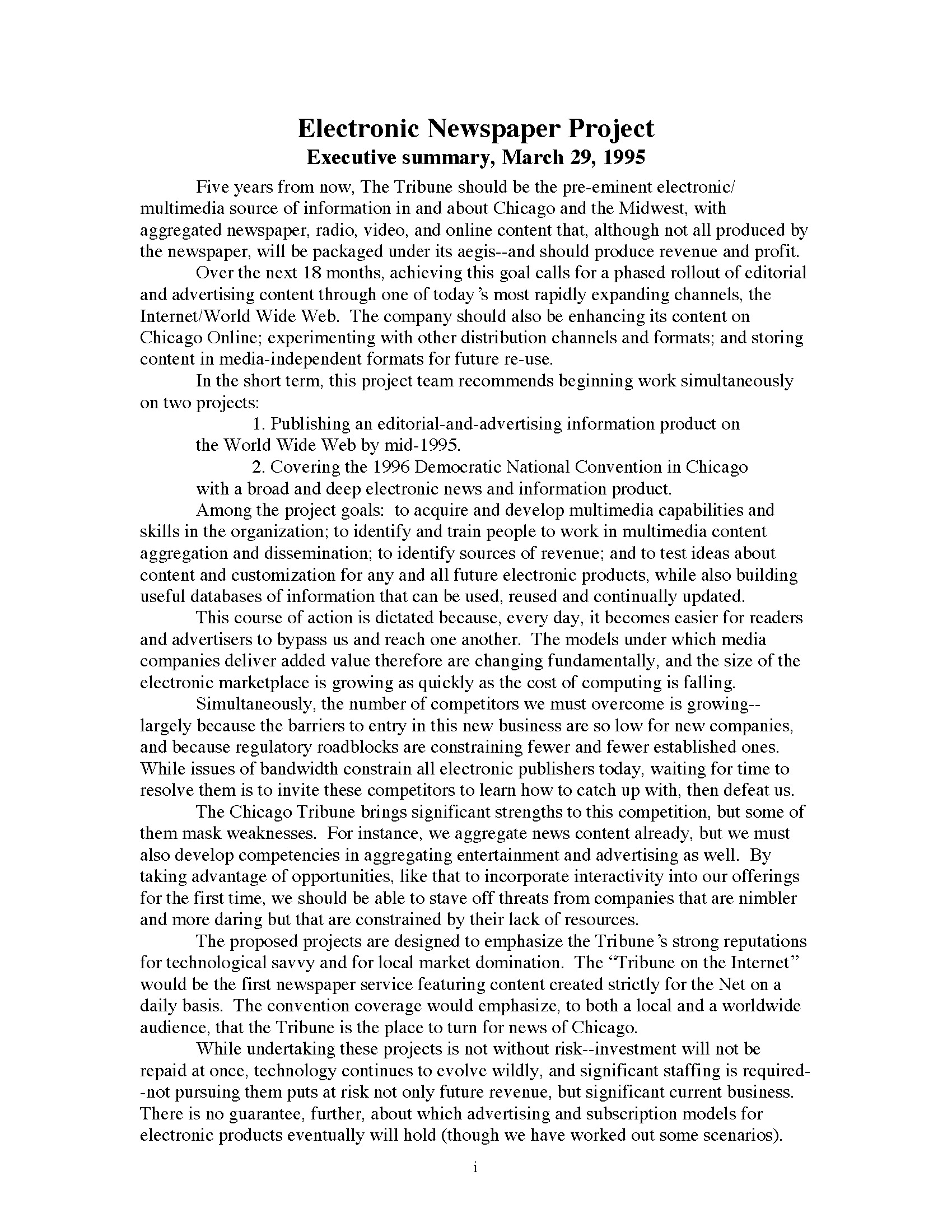
As you might suspect, a principal reason I didn’t know is that, inside Chicago Tribune Digital Publishing, we were calling Digital City Arlington Heights and Digital City Evanston something else: “virtual communities.” (Why? Because our 1995 strategic planning documents had called them that.) In fact, the word “hyperlocal” had yet to appear in either the Tribune or the New York Times . . . and when it did, each paper first used it in a story about television news (NYT, 7/14/97; CT, 12/24/98).

Well, that was then. By now, across this great land of ours, tens of thousands of Web sites and blogs focusing on news and information at the neighborhood, community, or suburban level have arrived (and in many cases departed), fully embracing their hyperlocalness. (Hmm. “Blogs.” Another coinage that hadn’t made the Tribune yet by then, although in researching this post I found an amazingly prescient piece about them by Julia Keller in September of 1999 that’s worth a detour.) Tens of millions of dollars have been expended to build these hyperlocal sites; some fraction of that amount has even been recouped in advertising.

And still the impetus to build new ones, operate them, and change the course of hyperlocal history has never been stronger, if we are to judge by the Patches and Triblocals of this world. So this quarter’s Community Media / Interactive Innovation Project course at Medill, with financial support from the Chicago Community Trust, took as its charge to research, understand, and propose new paths for hyperlocal news, technology, content, and advertising.  Medill Professor Rich Gordon has led the effort; now, as the quarter is nearing an end, the results and the recommendations are starting to roll in.

This is now (2010).

Not that I’m going to give away (yet) the innovations that these 15 graduate journalism students have created and are in the process of promulgating.  I will, however, tell you that

  • The blog they’ve been writing all quarter, localfourth.com, is already full of insights, ideas, and epiphanies.
  • The business and revenue team that I have been advising has published its “cookbook” of ideas for hyperlocal publishers interested in seeing their sites become financially sustainable.  You can read it on Scribd, read about it on localfourth, or download it through their webform.
  • You can watch the site for their full final report, coming soon.
  • You can get ready to put their ideas for a hyperlocal Web site to the test when it reaches public beta, soon.
  • And finally, if you are intrigued enough by any of the above, you can hear their final presentation at 5 p.m. Thursday, Dec. 9, in the McCormick Tribune Center Forum on Northwestern’s Evanston campus.

(Oh, why “Local Fourth”? As the site’s “About” page puts it, “Our name, Local Fourth, is an attempt to localize the ‘fourth estate’ — a reference to newspapers and community members serving a watchdog role.”)

I realized as I was getting ready for this quarter that I have been involved in some form of hyperlocal news in the Chicago area for nearly 30 years now, going back to a stint overseeing prep sports at the Suburban Trib at the beginning of the 1980s, continuing through a tour of duty as suburban editor of the Tribune, launching 17 suburb-level Digital City sites in the mid- to late 1990s, and finally overseeing the launch of Triblocal and Triblocal.com before I departed Trib Tower for the ivory tower in 2008. That makes me especially excited by the work that has been done this quarter.

Or should I have said it makes me especially hyper?