Archive for the ‘By ORY’ Category

Take that, winter!

Wednesday, December 30th, 2009

‘Tis winter now; the fallen snow
has left the heavens all coldly clear;
through leafless boughs the sharp winds blow,
and all the earth lies dead and drear.

–Samuel Longfellow*

So let’s say you are not dismayed that Longfellow’s sharp winds are blowing (“the skies are chill, and frosts are keen”).  In fact, you’re nicely bundled up, wearing insulated mittens, among other accoutrements of the season.

And your iPhone alerts you that someone has just texted you.

So now those nice, thick mittens are causing you a problem: to respond to that text after you fumble for the phone, you’re going to have to expose your electrically charged fingers to the keen frost.

pogosketch2
Admittedly, it hasn’t been all that cold around here since about 1986 – well before the era of capacitave touch interfaces. But for those of you in Fargo, Flin Flon, and Fairbanks, I would like to alert you to a solution that appeared among my Christmas gifts: the Pogo Sketch from Ten One Design in Montclair, N.J. (average low in January, 19 degrees; record low, minus 14 degrees, 1985).

This battery-operated aluminum stylus, the size of a small pen, transmits an electrical charge through its cushioned tips, so you can keep those pinkies toasty when using your iPhone, Droid, Storm, or similar labor-saving/time-wasting device.

So grab your phone, your Pogo Sketch and your mittens, and head for Frostbite Falls.  Minnesota is lovely this time of year, don’t you think?

(* younger brother of Henry Wadsworth Longfellow)

It’s an e-reader! No, it’s a tablet! No, it’s . . . a means to an end

Sunday, December 27th, 2009

a30_businessIt seems that one of the questions I got asked most frequently in 2009 – at weddings, in email, in the church narthex, at Northwestern – was some version of “Should I get a Kindle?”  Even people who aren’t sure assume that I have one (and indeed, thanks to the generosity of friends, I have a couple).

The most recent version of the query came from Tribune literary editor Liz Taylor, who wondered if I could write a piece for the Printers Row pages of the Saturday Tribune on “why you use it, and maybe some tips . . . but as a WORD person, who loves books no matter what the form.” Well, sure. You can see the result, from the Dec. 26 edition, here.

Meanwhile, it seems that there were nearly as many articles on e-readers published this Christmas season as there were books to consume on them.  Christmas morning, for instance, the Trib business section reported on shortages and / or delayed launches of several Kindle competitors; on Christmas Eve morning the NYT’s “Bits” blog used an interview with Jeff Bezos and some data mining of customer comments to lay out a reason why all those competitors were rushing to get into the market.  It’s getting to the point that covering e-readers is like covering presidential politics: lots of focus on the horse race, very little on either the technology or the use case.

Which is why I probably enjoyed the Economist’s Dec. 12th piece, “Read all about it,” more than most.  It’s mostly about the display technology behind the readers; as the piece’s pullout summary puts it, “Readers of electronic books must choose between long battery life or vibrant, living colour. Could they have both?”  This is the place to go if you want to read about choleristic LCD’s and electophoretic displays, among other contenders to provide an answer to that question . . . while responsibly pointing out that “in the history of ingenious display technologies, only a handful have ever made it into mass production.”

(more…)

It was 40 years ago today

Wednesday, December 16th, 2009
stub

My first pay stub came with a motto: "Support those who support the Star-Beacon." Still true today.

There used to be lots of jobs, good jobs, in the newspaper business.

I had one. It paid me $1.60 an hour, which meant if I stayed really busy on the weekends and in the evenings, I might make $60 before taxes. Pretty good for a high school kid.

How good? In 2009 dollars, the government’s CPI calculator tells me, that would be about $353.  More than gas money.  More than a paper route.

newsboyIt was the Ashtabula Star-Beacon, a 6-day-a-week P.M. paper.  And, in fact, earlier in the fall, I had indeed been delivering it. I even wound up on the cover of its annual “salute to carriers” special section (right). I actually hadn’t been a paperboy all that long, as it took me far too long to learn to ride a bicycle.  But my route, fairly close to my house and the high school, was a decent way to get me out of the library and into the out-of-doors, and like I said, the Star-Beacon was a P.M., so even at the age of 16, I was still doing it. (The kids who delivered the Cleveland Plain Dealer had to get up waaaay too early in the morning.)

In November, though, the sports editor of the Star-Beacon called Tony Chiacchiero, football coach and head guidance counselor at Ashtabula High School, looking for someone to work part-time covering games and taking photos.  I had spent the previous two football seasons as statistician for the Panther football team, traipsing up and down the sidelines with a clipboard – a job that Coach Chiacchiero had given me because, in his completely accurate guidance-counselor estimation, I could use a little socialization.

“I have just the kid,” the coach said.  Or words to that effect.

(more…)

Co-operative-etition, Chicago style

Tuesday, November 24th, 2009

The festival of links you can create these days when writing about new business models for the news industry is a wonder to behold. As we have noted here before, it seems sometimes there are almost as many conferences on the topic as there are stories about paid content, most of them involving Rupert Murdoch and/or Google.

Chicago News Cooperative logoOne prominent example, of course, is beginning to play out right here in Chicago: The Chicago News Cooperative launched last week, publishing two-page reports in the Friday and Sunday editions of the New York Times. I of course am watching with much interest, given that, by my count, I worked at the Tribune with around three-quarters of the 20 people named on the staff page today.

I suspect the Tribune and Sun-Times are watching with interest, too, given that the Tribune chose Sunday to publish another [not "the second" as originally reported--ORY] in a series of spadeas about its priorities (Capturing the Chicago Experience – click to download PDF, 3.44 mB). Its letter to readers from editor Gerry Kern ends, “We are Chicago’s newspaper. We tell your stories.”

(By my lights, the most remarkable thing about the Chicago News Cooperative example is that the NYT’s own journalists actually wrote about the launch. I guess that’s another example of how the world is changing; in the Olden Days, writing about anything your employer had done to try to improve its business prospects had a good chance to get you hooted out of any newsroom in America.)

But let’s not spend any more time here on background.  If you want more, read Alan Mutter’s piece at “Reflections of a Newsosaur” from earlier this month. Instead, let’s see what Chicago readers found in their driveways and newsstands Friday and Sunday morning, and not just in the NYT (using the acronym consistently today, to avoid confusion).

After all, CNC editor Jim O’Shea and his colleagues say they’re not out to supplant the existing newspapers; they are out to protect and sustain a kind of reporting they perceive as threatened, the public-service journalism “that we feel is crucial for a democracy . . . and provide accountability for the institutions and public officials in the city, county and state.” (Quote is from a WTTW interview with O’Shea, video after the jump.)

(more…)

Winter: A season for a few good books

Thursday, November 19th, 2009

Great Horned Owl

Great Horned Owl

Well, it was pretty exciting in Deerfield tonight, what with a Great Horned Owl calling from two blocks down the street at 8:45. Of course, the only reason I was outside to hear him was that I was straggling home from Northwestern at that hour, extracting my daily quota of catalogs from the mailbox.

And the reason I was straggling home was that I stayed in Evanston until I had more or less finalized a reading list for my winter class for graduate students. The winter term is almost as close as actual winter: It starts Jan. 4 at 9 a.m.

It’s the reading list work that has kept me away from blogging the last couple weeks:

  • The good news for me is that I worked my way through thousands of pages chock full of good ideas and trenchant observations, many of them published over just the past few weeks and months.
  • The good news for my students is that part of the exercise was identifying the absolutely most pertinent few pages in each of these books to assign to them.
  • And the even better news for me, my students, and the copyright holders is that my colleague Dr. Rachel Davis Mersey pointed me to a company, University Readers, that handles copyright clearances for book excerpts and then assembles them into a “course pack” that students can buy for a tiny fraction of the cost of that stack o’ books.

My nearly final draft of the syllabus begins this way:

The objectives of this course are

  • first, to reset the starting point from which students view both the craft and the business of journalism;
  • second, to familiarize students with the media industry and its rapidly changing practices in areas including business, operations, technology and content; and
  • third, to position students to capitalize on changes they encounter during their careers.

So, in order to accomplish that, what have I been reading?  After the jump, you will find a partial bibliography of my reading list.

41B7NrA03OL._SS500_Of course, some books are too interesting or important or trenchant or closely argued to be excerpted.  Such a book is the new Ken Auletta, Googled: The End of the World As We Know It. So alone among my recent readings, that’ll be one we peruse from beginning to end.

Owen's Wired collectionOne more observation:  Wired magazine remains tremendous.  Several recent pieces also made the cut, making me glad that I not only have maintained my subscription, but that I keep them handy on my office shelves.

At any rate, now it’s time to move on to the lectures and presentations.  But I sure have a lot of ideas in my head to play with.  Oh, and if you take the trouble to go to the jump and look at my recent reading, do me a favor:  If you see some recent book that I should be diving into, by all means let me know.

(more…)

Looking for business models? Mind the gaps

Friday, October 30th, 2009

I suppose that every day is a good day to talk about how and whether the journalistic enterprise will remain commercially viable as the world turns in these days of our lives, or indeed whether all my children can recover from their financial ailments, be released from the General Hospital, and find a guiding light to lead them to the promised land of free cash flow. Progress on “new business models,” however, seems to move along at about the same pace as a soap opera plot – even though hardly a day passes without an announcement that someone is going to try something new, or someone else is going to essay something old in a new way.

Indeed it was thus on Thursday, a day when I opened the New York Times to read about the plans by the folks behind Politico to compete online with the Washington Post on local news. And I was actually in a good spot to keep thinking about their admission that they didn’t know how the Web economics might work; since the dean of Medill, John Lavine, had another commitment, I was at Harvard, sitting in at an “executive session” on, ahem, news business models.

Entitled “How to Make Money in News: New Business Models for the 21st Century,” the event gathered an intentionally small group at the Charles Hotel in Cambridge: about 20 panelists for the day’s three discussions, and about 30 additional participants on hand both to listen and to take part. Alex Jones, director of the Joan Shorenstein Center on the Press, Politics, and Public Policy, and author most recently of Losing the News: The Future of the News that Feeds Democracy, was the convener.

As it turned out, the three panels were so packed with speakers with something to say  that many of us other participants – who sat in chairs ringing a central square of tables where the panelists faced one other – got in our licks à la mode du 21ème siècle: 140 characters at a time.

Now, granted, this may not have been optimal.  In her prepared remarks, MIT’s legendary Sherry Turkle – generously not calling attention to anyone seated behind her or on the flanks – pointed to the substantial body of research that shows “your ability for any single task goes down when you multitask. No matter how much we want to jump on the bandwagon, multitasking degrades performance.”

I therefore must cop to the fact that none of my listening, note-taking, or tweeting were as good as they might have been. On the other hand, I must also say that those of us who were intermittently posting and reading got a window in what an additional 10 people were thinking, were piecing together, or were valuing as interesting (or, in some cases, not thinking, not piecing, not valuing). If you’re interested, you can recreate the moment by searching Twitter for the hashtags #Shorenstein and #newsmoney, with far more at the former; I certainly won’t get to all the sound bites here. My own tweetstream is at twitter.com/YoungOwen.

Multitasking, Harvard Square style: in-mirror televison

Multitasking, Harvard Square style: in-mirror televison

(Oh, while we’re on the subject of multitasking, staying at the Charles Hotel provided me with a new model.  I guess they’ve been around since 2006 or so, but the Charles’ bathrooms feature “in-mirror TV’s” from a company called Séura, whose web site explains, “Enhanced color correcting technology allows the LCD picture to appear when on, while flawlessly concealing the screen behind a bright reflection when off.” Turkle, I am sure, would rightly caution us that there is a risk of degrading the quality of one’s ablutions in the process.)

Turkle’s actual multitasking point, by the way, was centered on how journalists should choose their methods and channels of communicating. “Newspaper reading creates a ‘reading space’ that journalism occupies,” she said. “The teenagers I study leave us with a profound question: Will we be able to have journalism when we don’t have newspapers to appear in? Reading on the Web, if it is all you do, does not favor complex lines of thought. So the implication for news is to stay with narratives that need to be read with all one’s attention.”

(more…)

There were giants. . .no, there are giants.

Friday, October 16th, 2009

David Axelrod was grateful.  His Secret Service guy, I’m not so sure about.

It was Saturday night in Greektown, and about a hundred more-or-less-literally-ink-stained wretches were shaking their heads and shaking each other’s hands at the Parthenon restaurant.  It was a reunion of Chicago Tribune newsroom employees from the mid-sixties to mid-seventies.  You could read that as either their current ages or their decades of employment and, for the most part, be pretty close to right.

In my online invite from Sel Yackley (corrected 10/17; sorry, Sel), the event had been billed as having a 1975 cutoff for participation, but who would begrudge a presidential adviser a few lousy months?  Though Axelrod couldn’t stay for dinner . . . his Secret Service guy  was waiting offstage to whisk him away for another commitment . . . David summoned up his first days at the Tower and first stories in the paper.  It was June 14, 1976, and he was wearing his best suit.  It wouldn’t stay clean for long.

He was on his way to Lemont with the casually attired Jeff Lyon to write sidebars on the previous night’s killer tornado. The town was a mess, but not the prose on page 2 of the next day’s paper, a shared Lyon/Axelrod byline (with another Axelrod piece nearby):

“Possessions–bowling shoes, toilets, lasagna packets, princess phones, dishwashers, cheese graters, Christmas tree lights, and wagon wheels–lay set out as at some grotesque garage sale. But the garages, along with the most of the homes and trees along McCarthy Road from McCarthy Street to Walker Road, were gone.”

tornadotrim1

After the storm: Click for PDF of photos and text

Then he moved on to the next day and his even riskier next assignment: Finding a Teamster or two willing to talk on the record about their president’s 25% raise to $156,250 a year, which was coupled with a doubling of their dues. Well, he found one, and the story ran on Page One.  (That salary would be $593,060 in today’s dollars, according to the Bureau of Labor Statistics, if you’re scoring at home.)

A pretty good first couple of days at the office, if you ask me.  But Axelrod was not taking the credit.  No, he pointed to Jon Van, sitting out in the Parthenon banquet hall.  ”And so I started to learn the value of rewrite men.”

(more…)

This is your brain. This is your brain on Twitter.

Thursday, October 1st, 2009

My colleague Ellen Shearer posted a link to the Medill faculty listserv yesterday  about a recent academic study in Scotland with a headline-grabbing conclusion.  In fact, let me quote the headline from the Telegraph:

Facebook ‘enhances intelligence’ but Twitter ‘diminishes it’, claims psychologist

Dr. Tracy Alloway, from the University of Stirling in Scotland, did the study with 11- to 14-year-olds. It indicates that, more specifically,

Playing video war games and solving Sudoku may have the same effect as keeping up to date with Facebook . . . But text messaging, micro-blogging on Twitter and watching YouTube were all likely to weaken ”working memory.”

”On Twitter you receive an endless stream of information, but it’s also very succinct,” said Dr. Alloway. ”You don’t have to process that information. Your attention span is being reduced and you’re not engaging your brain and improving nerve connections.”

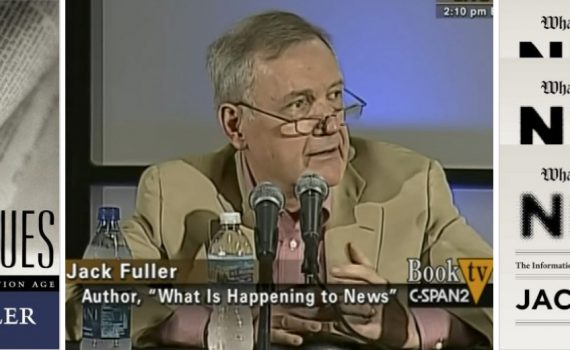
This matter of how the brain processes information is of great interest to many people. One of them is my former Tribune boss Jack Fuller, who in fact has devoted the last several years to this topic himself, particularly to the piece that explores how people absorb and understand news. Indeed, he has a book coming out next April from the University of Chicago, What Has Been Happening to News, that explores the topic in depth.

He allowed me to read it in typescript, and I won’t steal of any of its thunder now.  But more than two years ago, in a Tribune Perspective piece entitled “Reasoning With Feeling: Boosters of the Internet see it as a perfect forum for reasoned debate. But neuroscience tells us that emotions keep popping up,” he began to explore what he was learning.

Neuroscience came into its own at about the same time the Internet did. In the past couple decades, new techniques for peering into brain processes haveled to extraordinary advances in understanding the mind. These have profoundly refigured the picture that came down to us from philosophers and early generations of psychologists.

One area is particularly fascinating: The new model of the mind offers important but unsettling insights into why people respond to today’s media as they do.

The archived piece is worth a spin (though the parser that put it up on the Tribune archive site does a lousy job with word spacing every 80 characters or so). Essentially, Jack is exploring a different issue than the Scottish researcher: not the diminishment of intelligence, but the primacy of emotion “[w]hen the brain is challenged to process very difficult information – let’s say, multitasking amid an overload of information.”

Come the spring, you will want to read Jack’s book.  In the meantime, however, I guess I will feel good that I spend more time on Facebook than either Twitter or YouTube.

Though you could argue it might be a better demonstration of intelligence, diminishing or otherwise, to spend less time with both.