Archive for January, 2010

“All passes. Art alone endures.”

Wednesday, January 27th, 2010

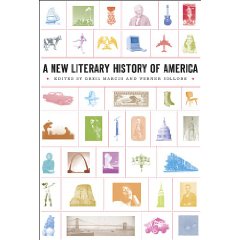
51q7RzjhPKL._SL500_AA240_Monday night on the way home from Northwestern, I stopped at the local Borders in order (finally) to act on a pre-Christmas recommendation from Tribune literary editor Liz Taylor: to purchase A New Literary History of America, edited by Greil Marcus and Werner Sollors. Before long I was reading about The Wonderful Wizard of Oz, The Great Gatsby, The Southern Harmony . . . and there were still a thousand pages to pick from. (This timeline is a great thing to scan for a sense of this remarkable compendium of new writing. Fifty bucks list, but with a gift card and a coupon it seemed like a good thing to actually pick up in a bricks-and-mortar store.)

I didn’t want to overdose, though, so after a while I set it down and belatedly picked up Sunday’s edition of the New York Times Book Review. In so doing, I thought I would be transitioning from the past to the present, in addition to reducing the weight of the analog object in hand.

But no.

More than meets the eye, or the cursor for that matter.

More than meets the eye, or the cursor for that matter.

As it happened, the Book Review was upside down in my stack of unfinished reading, and on the back page was the monthly ad from Bauman Rare Books in New York City. I usually do spend a couple of seconds glancing at the store’s featured offerings, but this week it stopped me cold. And I quote:

  • John Milton: Paradise Lost, 1668. “One of the greatest, most noble and sublime poems which either this age or nation has produced.” First edition of Milton’s masterpiece, in contemporary calf.
  • Mark Twain: The Adventures of Huckleberry Finn, 1885. “All modern literature comes from one book by Mark Twain. It’s the best book we’ve had” (Ernest Hemingway). An extraordinary American rarity: Mark Twain’s own copy of Huck Finn, signed by him, in publisher’s sheep. Full first issue, one of the earliest known copies.
  • F. Scott Fitzgerald: The Great Gatsby, 1925. One of the great rarities in American literature: first edition in the first-issue dust jacket of one of the most desirable works in modern literature.

It’s not like I had set out to muffle the drumbeats in advance of what turned out to be the Apple iPad. And maybe it was because I had just been reading about Scott and Zelda and Gatsby and Nick Carraway in the New Literary History. For whatever proximate cause, I was thinking not just about the titles or the authors or the cultural resonance of either, but also about the form factor that is part of what transformed these objects into not just collectibles, but representations of the power of words, and of ideas.

At some point, should the Great American Novel ever be written, some substantial number of its readers will absorb it in a form utterly unconnected to such an artifact. Afflicted as they are by permanent partial attention disorder, they will labor doggedly to identify and retain “the good parts” across the multiple brief sessions of hard-won reading time they are able to devote to it. And when their children’s children come across it 30 years after acing their own 21st Century Literature classes, what will be the touchstone that summons up what two sentences on a first edition of Gatsby does today?

Over the stage at Norton Memorial Hall, the opera house on the campus of the Chautauqua Institution, are the words “All passes – Art alone endures.” As a lad, I would annually contemplate this translation from the poet Théophile Gautier (Tout passe. L’art robuste / Seul a l’éternité . . .) as I sat in services or meetings during a week-long family retreat held by the Covenant churches of what was then called the Middle East Conference. The speakers and conferees, of course, had a substantial disagreement with the details of that sentiment, but there it was, overhead, while they spoke and sang to different points below.

No, I didn’t know then it was Gautier, any more than I knew before noon Wednesday that the Apple tablet would be called the iPad, any more than I am able to answer my own question immediately above. I’m already reading on a Kindle and an iPhone; undoubtedly I will before long be reading on an iPad and a Que. But, a digital fellow though I may be, I find myself clinging to an emotional attachment to Bauman’s trove of objects that I never will have or hold.

No, they’re not the art, those objects; Hemingway and Fitzgerald do not endure because of their first-edition dust jackets. But I want to hope that the flash and dazzle of the Next Big Thing does not get in the way of the establishment of the Next Important Thing. And these days, I’m not feeling all too sure.

Life at the confluence

Saturday, January 23rd, 2010
The prototypical confluence

The prototypical confluence

It was a regular, and solemn, invocation for Monday Night Football in the years when the Pittsburgh Steelers turned up there as often as ABC and the NFL could manage it: Howard Cosell, in his fullest declamatory splendor, telling America that he and we would spend the next several hours “at the confluence of the Al-le-ghe-ny and Mo-non-ga-he-la Rivers” – the origin of the Ohio River, and therefore the very eponym of Three Rivers Stadium.

There are a couple of football games this weekend that don’t include the Steelers, but we are spending the end of January at a confluence nonetheless.  Two mighty rivers of ink are flowing together, inexorably, even as we speak: that which has been spilled in anticipation of the Apple tablet, and that which has been spilled in anticipation of the emergence of a coherent strategy for paid news content on the World Wide Web. For a handy list o’ links that should satisfy your need to drown in either river, visit the Nieman Journalism Lab for Mark Coddington’s week in review.

Perhaps it was when Bill Keller, editor of the NYT, talked about an “impending Apple tablet” to his staff in October that the stories became inevitably linked.  But, once the Times sketchily sketched out the state of its sketchy plans on Wednesday morning, we had to wait less than 24 hours for the heartwarming Wall St. Journal headline, “Apple Sees New Money in Old Media.”

In between – actually, just a few minutes after the Times announcement on Wednesday – I was in front of a class of first-quarter Medill graduate students, introducing them to some of the ideas that I flesh out further in my current class, “How 21st Century Media Work.” The Q&A centered not on the Times, but on the larger question of finding the money to support the journalism they feel called to do.

As a matter of fact, my answers dipped a toe into each of the merging rivers.

  • I do expect to see models for paid content emerging, and this year; some will be for-profit (GlobalPost), some low-profit (Chicago News Cooperative), some nonprofit and intentionally so (Texas Tribune).  They will have in common a focus on what their users find valuable, not their managers.
  • I do expect that many new devices will carry with them ways to extract revenue in exchange for the convenience or other value they bring; the media’s battle for desktop revenue will be miserable, but the chance for different models to flourish in the palm of your hand seem high.

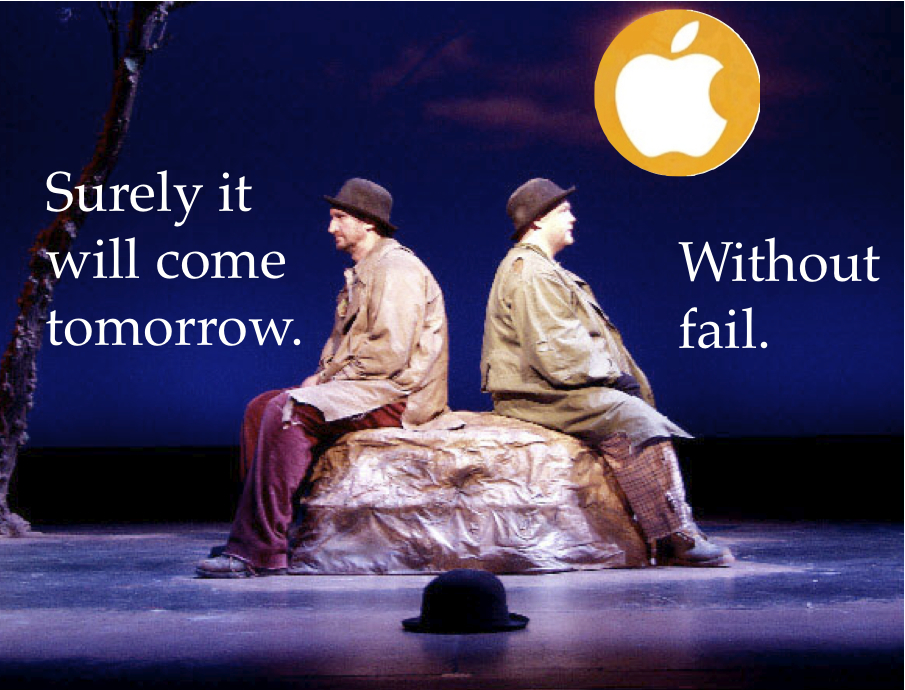
Meanwhile, it’s back to waiting – till 2011 for the debut of the Times pay wall; till next Wednesday for whatever it is that Apple wants to tell us. Hey, Vladimir!  Hey, Estragon! Can I wait alongside you?

cropgodot

Don and Lou, and Lou and me

Monday, January 18th, 2010
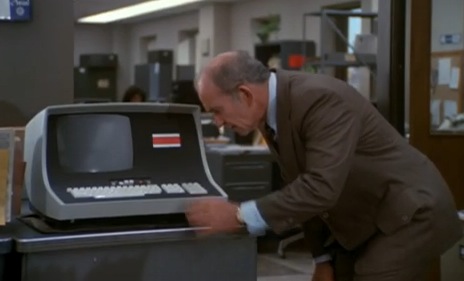
Lou Grant meets the future of newspaper technology, 1977

Lou Grant meets the future of newspaper technology, 1977

My former Tribune colleague Don Terry, who is reporting these days for the Chicago News Cooperative, has written a feature for the Columbia Journalism Review in which he views the current state of the newspaper business partly through the prism of a 32-year-old television show. As you will have surmised from the headline and image above, that show is “Lou Grant,” which for five years gave viewers a whiff of both The Front Page and the front page.

“Lou Grant” is pretty much the last TV series I ever watched, other than the Steven Spielberg-produced cartoon “Animaniacs.” That I watched it at all was an accident of scheduling: it began airing on Tuesday nights, and I was off from my job in the sports slot on Mondays, Tuesdays, and Wednesdays. That I stayed with it was probably due to the fact that its depiction the fictional Los Angeles Tribune newsroom seemed to get a lot of things right, as I was reminded first by Don’s piece, then by going to Hulu to watch the premiere episode last night.

If you’re interested, it would be far more effective to get the flavor of “Lou” from Don’s piece than to have me recreate a sliver of it, so go there (and you certainly should go there before going to Hulu. Of course, you’d expect me to say that; after all, I downloaded a Hulu player in December of 2007 but had never even fired it up).  From the remove of 32-plus years, though, I was particularly struck by the image above.

Lou is waiting to interview with an old pal for a job that he doesn’t understand will be city editor of the Tribune. Asked to wait, he turns around and comes face to screen with one of those CRT’s that, before too long, would replace the clattering typewriters in the newsroom, but for then was sitting, blank and mute, on a table outside the managing editor’s office.  He pauses.  He bends over.  He reaches to tap its keyboard. (I can’t seem to tell if it’s a Harris or an Atex or an Ontel or some other animal entirely.  He can’t seem to tell if touching it will singe his fingertips.) He looks up at the ME’s secretary, grins sheepishly, and walks away from this “machine,” as he refers to it shortly thereafter.

Before long, in the tradition of large metro newspapers everywhere, he is ensconced at the city desk without the benefit of a moment’s further training beyond that which he brought in the door minutes earlier.  He doesn’t need to be schooled in using that ungainly box, because the skills of his trade are working the phone, smelling the news, and flipping an underreported, overwritten story back at a hotshot reporter.

The good news is, those skills are still important; they are not going to come and go like the ungainly, literally dumb terminal Lou was inspecting above. (Of course, you don’t need quite as supple a wrist for the flipping part as you used to, if you’re quick on the double-click.) I’m thinking I’ll be reminded of other skills not to forget when I fire up the Hulu desktop for Episode 2, perhaps even before another couple years have passed.

So Twitter ‘will endure’?

Sunday, January 3rd, 2010

(Adapted from a post to the internal discussion board for my winter 2010 Medill course, “How 21st Century Media Work”)

“I’m convinced Twitter is here to stay,” David Carr writes in Sunday’s New York Times. “And I’m not alone.”

I’m thinking he’s probably right, and for the same reason: “the real value of the service is listening to a collective voice.”

It didn’t start that way for me any more than it did for Carr. It was July 16, 2007, when the Tribune’s Brad Moore told me about a new text-messaging service that RedEye had started to play with. He was reporting to me as its general manager then, and his folks were doing their best to stay on top of communication trends that its twentysomething readers were starting to embrace.

As it happened, I wouldn’t even join Facebook till August of that year, and FriendFeed, Fark, and Digg were even further in the future. Anyway, I signed up, though I didn’t get around to “tweeting” for another month. And it wasn’t until 2008, when the interns that I’d hired to build the Tribune’s social media profile started to show how Facebook + Twitter + Digg = Pageviews, that it dawned on me that those 140-character messages might be a big deal. So I opened a second account — @YoungOwen, the one I’m still using today, since I have been unsuccessful in getting Twitter to untether my first one from my extinct Tribune mobile phone.

And sure enough, I’ve learned enough from tweeting and reading other people’s tweets to see that, like fax machines and filing cabinets, this service is something that’s not going away. As Carr observes, it has become part of the infrastructure; he quotes Clay Shirky: “Anything that is useful to both dissidents in Iran and Martha Stewart has a lot going for it.”

It goes (almost) without saying that the precise business model hasn’t quite emerged. But let me be the one millionth person to note that countless companies are piggybacking on it, mining the real-time “statusphere” or “Twitterstream” to keep track of their brands, promote themselves, or find potential customers. All of those uses are applicable to journalists and media companies as well as technologists and gossips.

It is a peculiar and arcane skill, tweeting something that might be of interest to people you don’t know (which can happen all the time with the right #hashtag). But since journalists need to do that nearly every day in their “real lives,” it seems also to be a useful one.

If you’re not on Twitter, you could do worse than to follow Carr (@carr2n) and the nine users he highlights. You might well wind up deciding to tweet what you learn.

The year’s miracles in review

Friday, January 1st, 2010

If you need to fill the time between now and Monday morning (or whenever you resume your normal routine), here’s your chance to make sure you didn’t miss any of last year’s most popular ruminations here at owenyoungman.com.

(Hmmm; four of the top 10 are from October, and two more are from November. I must be promoting better of late.)

Happy new year.

How America was 2-1-3′d (Oct. 6): In which we are reminded what made the LA Times the LA Times, and how the LA Times made Los Angeles, and how the LA Times sometimes made me crazy. Past tense in all cases.

There were giants . . . no, there are giants (Oct. 16): In which I hang with a variety of legends at a Tribune reunion in Greektown. As at most such events, you remember some of what you want to say, but hear mostly what others want to tell you. As at few such events, you also get to observe David Axelrod’s Secret Service detail.

The future, not the pasture (May 29): In which a gathering of Tribune alumni leads to discussions of philanthropy, public policy, health care, higher education, and journalism, more or less but not precisely in that order.

Co-operative-etition, Chicago style (Nov. 24): In which we do not look behind the scenes at the Chicago News Cooperative. Rather, we look at the choices readers had on Friday and Sunday, its debut days in the NYT.

Adventures in paid content, with actual payment (May 21): In which we begin our second foray into the world of Internet paid content, on a personal level, and display a trophy of the early Web economy.

(more…)