Archive for November, 2009

Not dead yet, but for how much longer?

Monday, November 30th, 2009

As I have mentioned here a couple of times, the students of the fall Interactive Innovation Project at Medill have been studying the past, assessing the present, and projecting the future of obituaries as a form of journalism and as a source of audience and revenue for publishers. Today on its Web site, obitresearch.com, the class released a white paper, “The State of the American Obituary,” that contains their findings.

They report that the central position that newspapers have held in communicating the news of Americans’ deaths is substantially threatened by changes in technology and audience behavior. Unlike other categories of aggregated listings, this is an area where newspapers today still retain a dominant market share.  In fact, Legacy.com Inc. – the Evanston-based aggregator of newspaper death notices that sponsored the research project, and where (disclosure) I am an independent board member – hosts death notices for 7 of every 10 Americans who die each year.

The class found that new user- and family-driven forms of remembering the dead, on social networking sites like Facebook and MySpace as well as standalone memorial sites and services, are attracting audience members who want not only to read about their friends and loved ones, but also to participate in their memorialization. While this began happening as soon as the first Web browsers appeared, the growth of social media, particularly among the Baby Boom generation, is causing an acceleration.

In preparing their report, the eight students who worked on this project conducted quantitative and qualitative surveys, reviewed scholarly and industry research, and conducted interviews with employees at newspapers nationwide. Based on their findings, they conclude with recommendations to media stakeholders on how to adapt to the many changes in the landscape of grieving, remembering and memorializing the dead.

You can download the report here. It was principally written and edited by Ashley Bates, Ian Monroe, and Ming Zhuang.  Contributing researchers were Jake Bressler, Alina Dain, Chris Deaton, Tiffany Glick, and Kate Goshorn.

Co-operative-etition, Chicago style

Tuesday, November 24th, 2009

The festival of links you can create these days when writing about new business models for the news industry is a wonder to behold. As we have noted here before, it seems sometimes there are almost as many conferences on the topic as there are stories about paid content, most of them involving Rupert Murdoch and/or Google.

Chicago News Cooperative logoOne prominent example, of course, is beginning to play out right here in Chicago: The Chicago News Cooperative launched last week, publishing two-page reports in the Friday and Sunday editions of the New York Times. I of course am watching with much interest, given that, by my count, I worked at the Tribune with around three-quarters of the 20 people named on the staff page today.

I suspect the Tribune and Sun-Times are watching with interest, too, given that the Tribune chose Sunday to publish another [not "the second" as originally reported--ORY] in a series of spadeas about its priorities (Capturing the Chicago Experience – click to download PDF, 3.44 mB). Its letter to readers from editor Gerry Kern ends, “We are Chicago’s newspaper. We tell your stories.”

(By my lights, the most remarkable thing about the Chicago News Cooperative example is that the NYT’s own journalists actually wrote about the launch. I guess that’s another example of how the world is changing; in the Olden Days, writing about anything your employer had done to try to improve its business prospects had a good chance to get you hooted out of any newsroom in America.)

But let’s not spend any more time here on background.  If you want more, read Alan Mutter’s piece at “Reflections of a Newsosaur” from earlier this month. Instead, let’s see what Chicago readers found in their driveways and newsstands Friday and Sunday morning, and not just in the NYT (using the acronym consistently today, to avoid confusion).

After all, CNC editor Jim O’Shea and his colleagues say they’re not out to supplant the existing newspapers; they are out to protect and sustain a kind of reporting they perceive as threatened, the public-service journalism “that we feel is crucial for a democracy . . . and provide accountability for the institutions and public officials in the city, county and state.” (Quote is from a WTTW interview with O’Shea, video after the jump.)

(more…)

Winter: A season for a few good books

Thursday, November 19th, 2009

Great Horned Owl

Great Horned Owl

Well, it was pretty exciting in Deerfield tonight, what with a Great Horned Owl calling from two blocks down the street at 8:45. Of course, the only reason I was outside to hear him was that I was straggling home from Northwestern at that hour, extracting my daily quota of catalogs from the mailbox.

And the reason I was straggling home was that I stayed in Evanston until I had more or less finalized a reading list for my winter class for graduate students. The winter term is almost as close as actual winter: It starts Jan. 4 at 9 a.m.

It’s the reading list work that has kept me away from blogging the last couple weeks:

  • The good news for me is that I worked my way through thousands of pages chock full of good ideas and trenchant observations, many of them published over just the past few weeks and months.
  • The good news for my students is that part of the exercise was identifying the absolutely most pertinent few pages in each of these books to assign to them.
  • And the even better news for me, my students, and the copyright holders is that my colleague Dr. Rachel Davis Mersey pointed me to a company, University Readers, that handles copyright clearances for book excerpts and then assembles them into a “course pack” that students can buy for a tiny fraction of the cost of that stack o’ books.

My nearly final draft of the syllabus begins this way:

The objectives of this course are

  • first, to reset the starting point from which students view both the craft and the business of journalism;
  • second, to familiarize students with the media industry and its rapidly changing practices in areas including business, operations, technology and content; and
  • third, to position students to capitalize on changes they encounter during their careers.

So, in order to accomplish that, what have I been reading?  After the jump, you will find a partial bibliography of my reading list.

41B7NrA03OL._SS500_Of course, some books are too interesting or important or trenchant or closely argued to be excerpted.  Such a book is the new Ken Auletta, Googled: The End of the World As We Know It. So alone among my recent readings, that’ll be one we peruse from beginning to end.

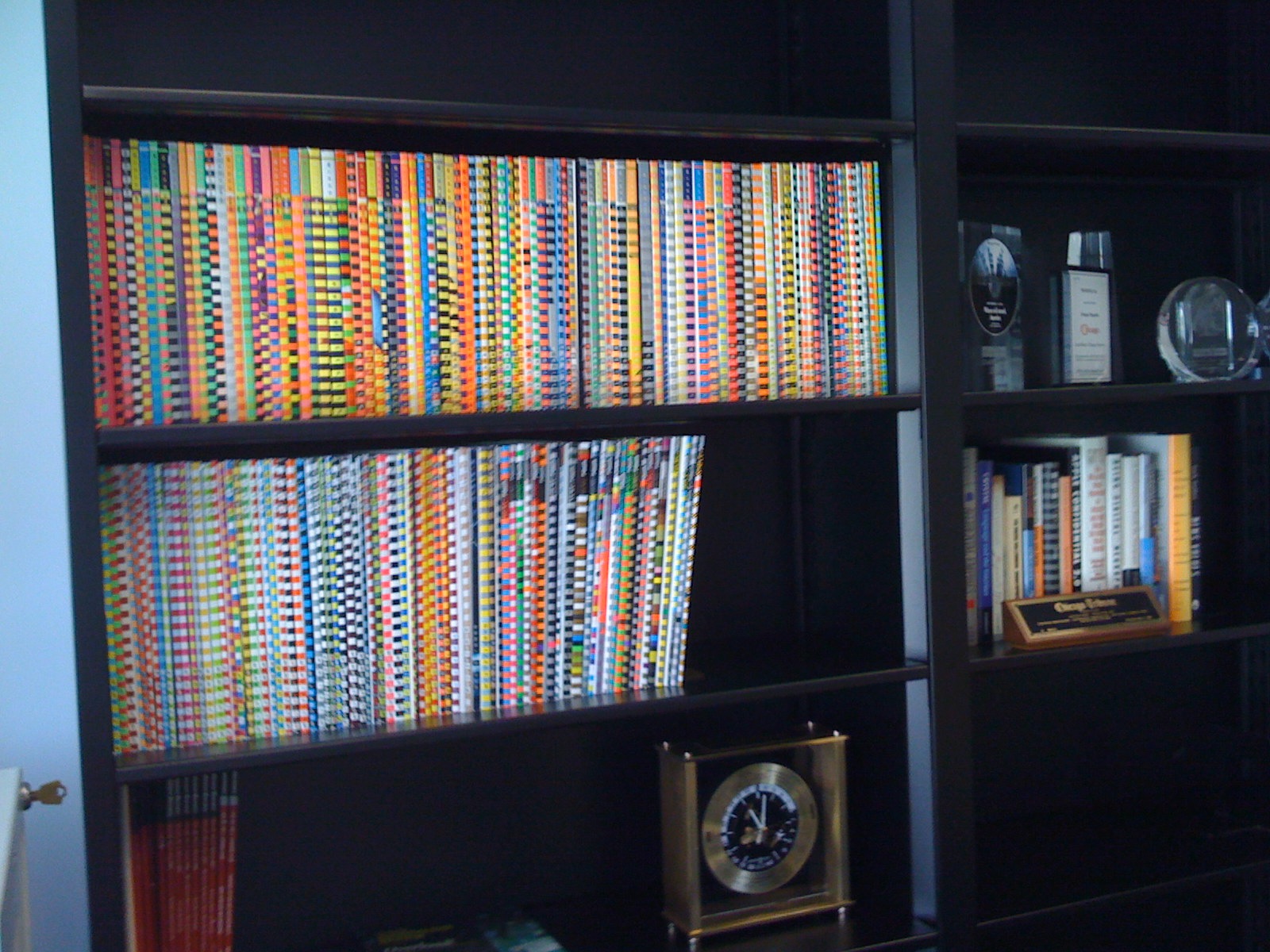
Owen's Wired collectionOne more observation:  Wired magazine remains tremendous.  Several recent pieces also made the cut, making me glad that I not only have maintained my subscription, but that I keep them handy on my office shelves.

At any rate, now it’s time to move on to the lectures and presentations.  But I sure have a lot of ideas in my head to play with.  Oh, and if you take the trouble to go to the jump and look at my recent reading, do me a favor:  If you see some recent book that I should be diving into, by all means let me know.

(more…)

Not dead yet (cont.)

Tuesday, November 3rd, 2009

Medill_logoAs I noted a month ago, this fall’s Interactive Innovation Project at Medill is an exploration of the state of the American obituary, and the eight graduate students with whom Rich Gordon and I are working are posting regularly on a blog at obitresearch.com.  There, I have recently learned

quite a bit more, including obituary practices at newspapers of different sizes.  And the class also has linked, each Friday, to a handful of interesting examples of obituaries and online memorials that run the gamut and then keep running.

The class’s final presentation isn’t till Dec. 10, so there is still lots more to learn.  Till then, I commend the site to your ongoing interest.