Archive for May, 2009

A by-the-book reader meets the Kindle (NYT)

Saturday, May 30th, 2009

The slim, envelope-size Kindle is undeniably convenient, even for the curmudgeonly. – Picture caption from  By-the-Book Reader Meets the Kindle – NYTimes.com.

==

This first-person article about the accommodations that even a “curmudgeon” is willing to make when the technology is good enough, and the use case is right, to me is another confirmation of my hypothesis that the Kindle is showing the way toward a future in which people get paid for the content they are able to deliver conveniently (emphasis most emphatically mine).  ’Nuff said; go read it.

The future, not the pasture

Friday, May 29th, 2009
Jack Fuller, Ann Marie Lipinski, Scott Smith, Howard Tyner, Alison Scholly Jack Fuller, Ann Marie Lipinski, Scott Smith, Howard Tyner, Alison Scholly

“Tell brave deeds of war.”

Then they recounted tales, –
“There were stern stands
And bitter runs for glory.”

Ah, I think there were braver deeds.

– Stephen Crane


And in fact, when three former editors and two former publishers of the Chicago Tribune gathered with two former general managers of the Tribune’s interactive business for lunch Friday at the Arts Club of Chicago, it was the braver deeds that dominated the conversation.

And, of course, the Connecticut warbler that spent most of the lunch in a tree just outside the club’s second-story dining room.

Unlike the newspaper industry meeting on Thursday in Rosemont, there were no outside lawyers present, though had we needed one former editor and publisher Jack Fuller certainly qualifies. But maybe there should have been, since when we discussed health care we could call upon our board and professional connections to Northwestern Memorial Hospital (Scott Smith), the University of Chicago Hospitals (Jack Fuller and Ann Marie Lipinski), and Swedish Covenant Hospital (Owen).

When we got to philanthropy, we had trustees of the Macarthur Foundation (Jack) and the McCormick Foundation (Scott). (We had been hoping for incoming McCormick CEO David Hiller, but my lunch with him isn’t till next week.)

On higher education, we had North Park University trustee Owen, University of Chicago VP for Civic Engagement Ann Marie, and U of C trustee Jack, not to mention plenty of informed opinion from Scott, who is of course deeply involved at Northwestern as well as a trustee at National-Louis. Less problematically from an antitrust perspective when the talked turned to journalism education, Medill was of course heavily represented, by alumni Howard Tyner, Alison Scholly, and Jack, plus professor Owen.

Also unlike that Thursday meeting, which former colleague Jim Warren broke online in The Atlantic, there was no top-secret agenda either to publish or to suppress. The occasion was to mark my retirement from the Tribune. Yes, that came last November, but just think of all the board meetings we’ve been going to.

In the intervening months, of course, I also wound up with this great job at Medill, and the gathered alumni were very interested and very encouraging. I ran a few of my incipient pedagogical ideas and philosophical constructs past the table, and you know what, I think I’ll keep working on them!

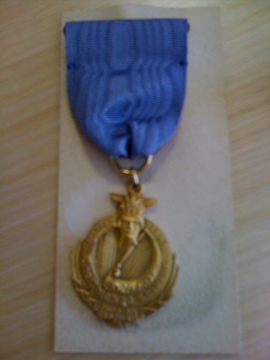
img_01782Really, the only virtual trip down St. Clair Street came when my friends showered me with gifts and remembrances. Here, for example, you see my very own Chicago Tribune Chicagoland Music Festival first-place medal, struck by C.D. Peacock. (The Festival, held every year from 1930 to 1966, was just one of the many events – the Golden Gloves, the Silver Skates, the College All-Star Football Game – that the Tribune gave to Chicago over the years. Jack fondly recalled the glow that suffused Soldier Field when, at the end of each Festival, the lights were turned down and everyone in attendance struck a match and held it aloft.)

Did we worry aloud about the current state of the world? Sure. Did we talk about how the Internet had changed everything? No, because we’d all been directly involved.

Did we wonder if things would get better in media land? No, we just discussed what would happen when it did.

Then they sent me back to Medill to get back to work on the next miracle. And so here I am.

Hmmm. Should Peter Pan have signed up for unlimited texting?

Wednesday, May 27th, 2009

It was 1995 or so when I first came across Sherry Turkle. Her book, “Life on the Screen: Identity in the Age of the Internet,” was intriguing academics, scaring parents, and launching incomprehensible book reviews from coast to coast.

Now, a quick word of caution: You can’t apply today’s context to the title. The MIT professor’s book was focused not on the just-emerging World Wide Web, but on the role-playing games that had been proliferating online and the people who inhabited the MUDs – multiple-user domains – that helped define them. Guess what: some of them viewed “RL” (real life) as just another role-playing game … another “screen” to be navigated through … and as such a world no more or less valid than that inhabited by any of their avatars.

But no, that’s not the scary part. (more…)

Adventures in paid content, with actual payment

Thursday, May 21st, 2009
The check was in the mail.  I didn't cash it, however.

The check was in the mail. I didn't cash it, however.

Drowned out in the buzz about the yet-to-appear Kindle DX a couple of weeks ago was the semi-related announcement that Amazon was opening the gates of remunerated e-publishing not only to newspapers and magazines, but to everyday bloggers.  Among the first to “sell out,” as he headlined it, was my industry colleague Steve Yelvington, who blogs at yelvington.com.

Yes, you now can pay a monthly fee to Amazon.com not just to read the New York Times or LA Times or Chicago Tribune on your current and future Kindle.  You also can pay them to get yelvington.com, although  ”I don’t know whether anyone will buy it (and I have my doubts, since the idiot who manages this operation gives away the same content on the Web),” he noted.

Well, us journalist types at the end of the alphabet need to stick together. So as of today version 11.0 of “The next miracle” is also available in a Kindle edition (is that version 11.1?), and the low monthly price of $1.99 “includes wireless delivery via Amazon Whispernet.”

Line up, sign up, subscribe today.

Plus, “Kindle Blogs are auto-delivered wirelessly to your Kindle and updated throughout the day so you can stay current.”

Plus plus, “It’s risk free—all Kindle Blog subscriptions start with a 14-day free trial. You can cancel at any time during the free trial period. If you enjoy your subscription, do nothing and it will automatically continue at the regular monthly price.”

Plus plus plus, I already know how to make money on the Internet!  Just look at the check at the top of this post!

Yes, in early 2000, I succumbed to another e-publishing siren song.  I signed up with MightyWords.com, which billed itself as ”a definitive digital marketplace for the written word.” According to Library Journal, MightyWords, which was launched by the evocatively named Fatbrain.com, “offers authors and publishers a new digital channel to read, write, buy, and sell written content, including essays, short stories, chapters, and additional works.”

“By creating the first digital marketplace to read, write, buy, and sell ideas, MightyWords will unleash a wealth of written content and will create a powerful distribution channel that will significantly affect the publishing world,” said Chris MacAskill, Fatbrain.com CEO. Well, who could resist?  Not me.  Even though it was available for free here at owenyoungman.com, I uploaded my 1997 travel essay “From Hong Kong to Hershey:  Or, I Liked the Thick Chocolate Shake More Than the Thick Soup of Snake” and waited for the royalties to roll in.

(more…)

The Internet, it’s a helluva town; the news is up, but the newsies are down (The Economist)

Tuesday, May 19th, 2009

The winds of ... (The Economist)

The winds of ... (The Economist)


(T)he plight of the news business does not presage the end of news. As large branches of the industry wither, new shoots are rising. The result is a business that is smaller and less profitable, but also more efficient and innovative.

via The news business: Tossed by a gale | The Economist.

New sources of news are proliferating online. Many, it is true, are unreliable. Most are badly funded. Some are the rantings of deranged extremists. But some—like Muckety, an American site which enriches news stories with interactive maps of the protagonists’ networks of influence, and NightJack, the revealing and depressing blog of an anonymous British policeman, which won the Orwell prize last month—enhance society’s understanding of itself, and could not have existed in the old world.

From the same issue, a leader: Media: The rebirth of news | The Economist.


Many of the hard lessons being learned around the industry this year and last are assembled in one place in these pieces from The Economist, living up to its reputation as the best source in the world for carefully selected obituaries.  No, wait, just kidding; of course it is the best place in the world to find those one or two obits you need to read per fortnight (this week: Margaret Gelling, “expert on British place names”). But taken together, and even taken separately, the editorial and the news story show a better than fair understanding of what has happened (“The main victim is not so much the newspaper . . . as the conventional news package”) and what might happen next.

(more…)

Students offer 5 ideas for marrying journalism, technology (Poynter)

Friday, May 15th, 2009

This semester, Medill’s Spring New Media Publishing Project offers journalism students an opportunity to design and build those new tools, working side-by-side with computer science faculty and students. Five teams are researching, designing, building and testing new information-driven applications. In the process, the journalism and computer science students are forging a common language and are starting to understand one another’s cultures.

via Poynter Online – Students Offer Five New Ideas for Marrying Journalism and Technology.

What Northwestern’s Jeremy Gilbert writes about here is very promising stuff indeed.  I have parachuted in a couple of times – once to do a brief presentation to the Medillians about successful collaboration with technologists, and just this week to begin helping with the project presentations that will climax the quarter. 

Much remains to be seen and done, but you are invited to stay up with the students’ work in progress on the class blog, www.writeclick.org.

We have turned, every one, to his own way

Thursday, May 14th, 2009


We have turned every one to his own way.

Have we like sheep all gone astray? (twittersheep.com)

Been just waiting and waiting for the right word cloud to come along, and thanks to a tweet from Nieman Labs and a post from Jay Rosen, here it is:  A word cloud drawn from the bios of those fine upstanding netizens who are following me on Twitter.

Try it yourself:  twittersheep.com.

An app and an attitude

Wednesday, May 13th, 2009

“Eye contact is a fundamental human signal — all kinds of studies have shown, for example, how people are more likely to cooperate with one another when they can make eye contact. When we don’t have it, when we become anonymous, we not only lose some of that impulse towards cooperation, we seem to become susceptible to all kinds of behavior we might not otherwise engage in.” –Tom Vanderbilt, author of “Traffic”; interviewed by amazon.com


I really like the book “Traffic,” which came out last year.  One of its interesting theses is that traffic is a social issue as well as a transportation issue, and that – given how much we time we spend in our cars – understanding traffic in that context both is informed by, and helps to explain, human nature.  As someone observed when it came out, its audiobook version would be a good choice for commuters.

Excuse me, did I just collide with your inbox?

Excuse me, did I just collide with your inbox?

I thought of the idea he explicates above again this morning, when my ex-Tribune pal Drew DeVigal of the NYT twittered a link to this story: “Email ‘n walk – compose emails while on the move.”  Relevant quotation: “The subject and message fields appear over the top of a instant video feed via your iPhone’s camera.  This way you can type AND walk without worrying about what may be in front of you.”

We could wring our hands about new excuses for stepping into traffic, but as the quote up above might indicate, I’d just as soon as wring my hands about the social piece.  Vanderbilt says in “Traffic” that, in a car, eye contact stops at 20 miles an hour, adding a whole layer of danger and uncertainty to the task of driving.

Even at a snail’s pace, and while engaged in way fewer than the 1,500 to 2,500 skills necessary to drive a car, emailing and walking … well, you get the idea.  It’s not about the obstacles you run into.  It’s about the isolation that gives your subconscious self permission to feign anonymity, isolation, and total focus in the midst of distracting multitasking.

Vanderbilt again: “As the inner life of the driver begins to come into focus, it is becoming clear not only that distraction is the single biggest problem on the road, but that we have little concept of just how distracted we are.”

It could be argued that today many people not only crave distraction, they wouldn’t know how to exist without it.  But there’s no one to argue with; they’re texting from behind the wheel, or while six feet away from the curb.

=======

ADD END, added 5/20: Drivers in Tennessee were the worst, with 42% admitting to texting and driving, according to Vlingo Corp., a maker of voice user interface software. 

via One in four mobile users admits driving while texting. | Computerworld

Hmmm.  If both the driver and the walker are texting, how will they ever form a social contract?